
Original Articles

Journal of Bio-Environment Control. 31 October 2022. 416-422
https://doi.org/10.12791/KSBEC.2022.31.4.416

ABSTRACT


MAIN

  • 서 론

  • 재료 및 방법

  •   1. 실험 재료

  •   2. 재배시스템 및 환경

  •   3. 생육조사

  •   4. Glucosinolate 함량 분석

  •   5. 통계분석

  • 결과 및 고찰

  •   1. 생육 분석

  •   2. Glucosinolate 함량 분석

서 론

십자화과(Brassicaceae)는 남 ∙ 북반구의 온대나 한대에 주로 분포하며, 지중해 연안과 중앙아시아에 걸쳐 생육하는 십자 모양으로 꽃이 피는 식물로(Kim와 Chin, 2018; Moon 등, 2006), 350개의 속, 약 3,000여 종이 보고되었다(Amina 등, 2020). 십자화과 작물에는 갓(Brassica juncea (L.) Czern., ‘적갓’), 적겨자(Brassica juncea L., ‘적대엽고채’), 케일(Brassica oleracea L. var. acephala (DC.) Alef., ‘레드러시안’) 등이 있으며, 쌈채소, 샐러드 등 다양한 요리에 쓰이고 있다. 이러한 십자화과 식물에는 글루코시놀레이트(glucosinolates, GSLs), 비타민C(ascorbic acid), 카로티노이드(carotenoids), 플라보이노드(flavonoids), 토코페롤(tocopherol), 폴리페놀(polyphenols)과 같은 기능성 성분 및 다양한 무기질 등의 함량이 풍부하다고 알려져 있다(Nawaz 등, 2018). 그 중 GSLs는 십자화과 작물의 대표적인 기능성 물질로 현재까지 약 200종류 이상이 알려져 있으며(Lee 등, 2019), 독특한 향과 매운맛의 근원이며 황과 질소의 저장소로 식물 방어 기작의 산물이다(Falk 등, 2007; Jeong 등, 2015). 또한, GSLs는 항바이러스, 발암 억제, 심근경색을 예방하며, 폐암과 위암 등 항암 작용을 하는 등(Miękus 등, 2020; Zhang 등, 2022)의 효능이 있어 많은 연구자가 관심을 두고 있다.

완전 제어형 식물공장 시스템은 작물 재배 시 광, 온도, 습도, 양액 조성, 이산화탄소 농도 등 다양한 환경조건을 계절이나 장소와 관계없이 제어하여 연중 생산할 수 있는 시스템을 말한다(Lee 등, 2016). 이 중 광은 광합성을 위한 에너지원으로 다양한 생리적인 반응을 유도한다(Abidi 등, 2013; Kelly 등, 2020). 하지만 식물공장에서 소비되는 총 전력량의 70-80%를 조명이 차지하기 때문에 작물 생산 비용 상승의 원인이 된다(Gao 등, 2020; Jin 등, 2022). 작물의 바이오매스를 생산하는 효율성을 최대화하거나 투자 비용을 절감하고 수확량과 수익성을 높일 수 있는 다양한 방법들이 있지만 광주기와 광강도를 이용한 일적산광량(DLI, daily light integral)를 최적화시키는 방법이 있다. DLI는 광강도와 광주기의 함수로 광합성을 일으키는 광자(광양자, photon)가 24시간 동안 식물이 받는 단위 면적당 공급된 빛의 총량을 말한다(Gao 등, 2020; Yan 등, 2019). 광강도 및 광주기에 변화를 주어 상추의 바이오매스 생산을 증가시키거나(Kelly 등, 2020; Yan 등, 2019; Zhang 등, 2018a) 안토시아닌 및 페놀 함량(Xu 등, 2021; Zhang 등, 2018b) 등이 달라지는 등 다양한 연구가 진행되었다. 하지만 동일한 DLI 조건에서 광주기와 광강도의 조합으로 십자화과 작물의 생장 및 기능성 물질 최적화에 관한 연구는 식물공장 현장에 많은 도움을 줄 수 있으므로 추가적인 연구가 필요하다. 따라서 본 연구는 같은 DLI 환경에서 서로 다른 광강도와 광주기를 조합한 4가지 조건이 십자화과 식물 3종의 생육 및 글루코시놀레이트 함량에 미치는 영향을 살펴보고자 수행되었다.

재료 및 방법

1. 실험 재료

아시아종묘(Asia Seed Co., Ltd., Seoul, Korea)에서 구매한 갓(Brassica juncea (L.) Czern., ‘적갓’), 적겨자(Brassica juncea L., ‘적대엽고채’), 케일(Brassica oleracea L. var. acephala (DC.) Alef, ‘레드러시안’) 종자를 포수된 암면플러그(AO Plug, Grodan, Poland)에 파종하여 105구 육묘 트레이에 정치하였다. 형광등(TLD 32W/865RS, Philips, Netherlands)을 이용하여 광주기 14/10시간(명/암), 광강도 180 ± 20μmol·m-2·s-1, 온도 22 ± 3℃, 상대습도 60 ± 10% 조건에서 3주간 육묘하였고, Yamazaki 양액 pH 6.5 ± 0.5, EC 1.5dS·m-1으로 본엽이 발생한 시점부터 2일 간격으로 저면관수를 실시하였다. 육묘 후 각 처리 당 24주씩 선발하여 직경 70mm 초록색 포트에 넣고 100mm의 간격으로 박막수경 시스템에 정식하였다.

2. 재배시스템 및 환경

환경조절룸[3m(길이) × 4m(폭) × 4.5m(높이)]에 재배 베드[1,380mm(길이) × 700mm(폭) × 2,075mm(높이)]를 3단, 각 단의 높이는 400mm로 구성하였으며, 각 단에 PVC 재질의 박막수경(nutrient film technique, NFT)[1,275mm(길이) × 115mm(폭) × 55mm(높이)] 베드 3개를 각 단에 정치하여 총 4개의 독립 재배 베드 모듈에서 실험을 수행하였다. 재배 베드 하단에 130L 크기의 양액 탱크를 제작하여 수중 펌프(PD-G050M, WILO Co., Ltd., Germany)를 이용하여 24시간 동안 순환시켰다. 온도 및 상대습도를 22 ± 3℃, 60 ± 10%로 유지하고 DLI 10mol·m-2·d-1을 기준으로 설정한 10h-280, 14h-200, 18h-155, 22h-127μmol·m-2·s-1 처리로 Yamzaki 양액 pH 6.5 ± 0.5, EC 1.5dS·m-1로 3주간 처리하였다.

3. 생육조사

정식 3주 후, 갓, 적겨자, 케일을 처리구별로 3주(n = 3)씩 수확하여 생육조사를 수행하였다. 생체중은 지상부와 지하부로 나누어 전자저울(MW-2N, CAS Co., Ltd., Korea)로 측정하였고, 건물중은 측정한 시료를 봉투에 담아 80℃로 설정된 열풍 건조기(HB-501M, Hanbaek Scientific Technology Co., Ltd., Bucheon, Korea)에 넣고 1주일간 건조한 후 전자저울을 이용하여 지상부와 지하부를 측정하였다. 작물 특성 분석 소프트웨어(KR-Image, ver. 0.9.5 beta, Korea Seed and Variety Service)를 이용하여 엽수와 엽면적을 측정하였다.

4. Glucosinolate 함량 분석

같은 DLI 조건에서 각각의 광강도와 광주기 처리에 따른 갓, 적겨자, 케일의 GSLs 함량은 (Mawlong 등, 2017)의 분석방법을 참고하여 분석하였다. 정식 3주 후 처리구별 3주씩 수확한 잎을 액체질소를 이용하여 급속 냉각시켰으며 ‒70℃에 냉동보관하였다. 냉동된 시료는 freeze-dryer(TFD5503, Ilsin Bio Base, Korea)를 이용하여 동결건조하였고 믹서기와 막자사발을 사용하여 분말화하였다. 분말된 시료는 2.0mL eppendorf-tube에 20mg을 넣고, 90% MeOH와 10% HCl 수용액을 넣어 제조한 1% HCl-Methanol 용매 2mL를 넣어 Voltex Mixer(SI-0246A, Coleparmer, USA)로 잘 섞어주었다. 시료와 용매가 혼합된 후 ultrasonic bath(Powersonic420, Hwashin Tech Co., Ltd., Korea)에서 중간 강도로 40°C, 20분 동안 음파 처리 후 추출하였다. 이후 원심분리기(Smart 15 plus, Hanil, Korea)를 이용하여 4℃, 15,000rpm으로 5분 동안 원심분리하여 상층액을 취하였다. 준비된 상층액 50µL과 2mM sodium tetrachloropalladate (Dissolved in 90% MeOH) 1.5mL를 1.5mL eppendorf-tube에 넣고 1시간 동안 상온에서 반응시켰다. 이후 96 well plate(SPL30096, SPL, Korea)에 200µL씩 분주하여 microplate spectrophotometer(Epoch™, Agilent Technologies, USA)로 425nm에서 흡광도를 측정하였다. 측정된 흡광도 값은 아래의 식으로 계산하여 함량 값을 구하였다.

Total glucosinolate (µmol·g) = 1.40 + 118.86 × A425nm

A425nm는 425nm에서 시료의 흡광도 값.

5. 통계분석

정식 3주 후 생육조사를 위해 각 처리구 당 3주(n = 3)를 조사하였으며, GSLs의 함량을 분석하기 위해 처리구 당 3개의 갓, 적겨자, 케일을 이용하였다. 측정한 데이터의 처리 간 통계분석을 위해 SPSS(SPSS 26, SPSS Inc., Chicago, IL, USA) 프로그램을 사용하였으며, 평균 간 유의차 검증을 위해 Duncan의 다중검정법으로 유의수준 p ≤ 0.05에서 분석하였다.

결과 및 고찰

1. 생육 분석

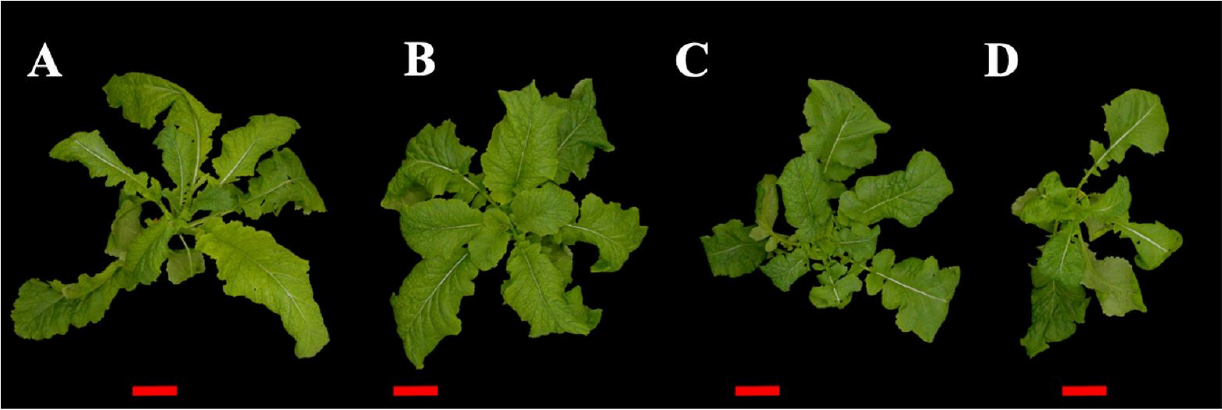
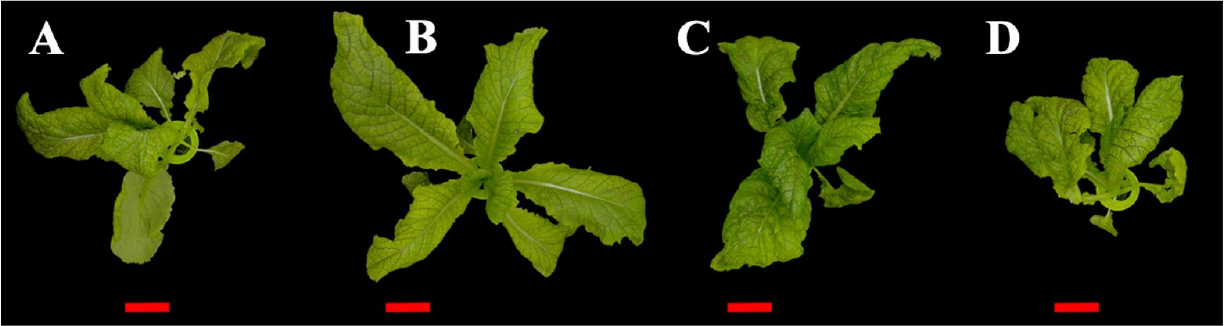
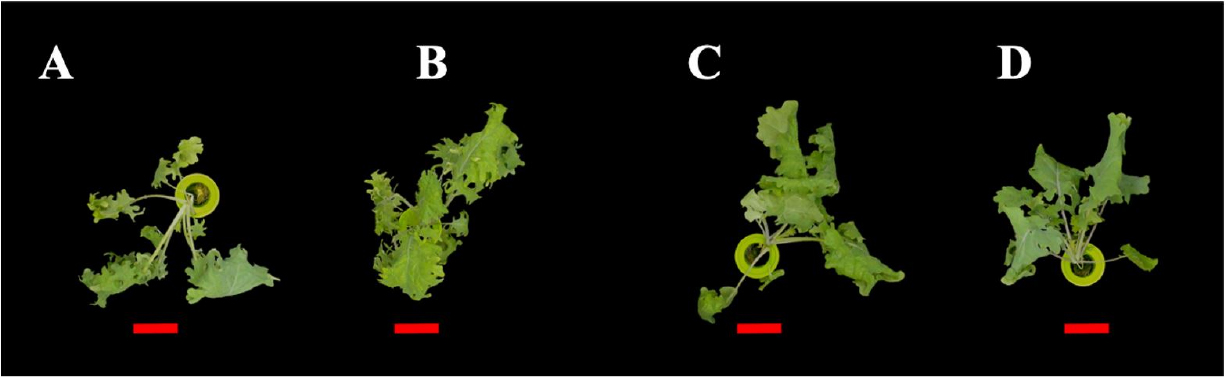
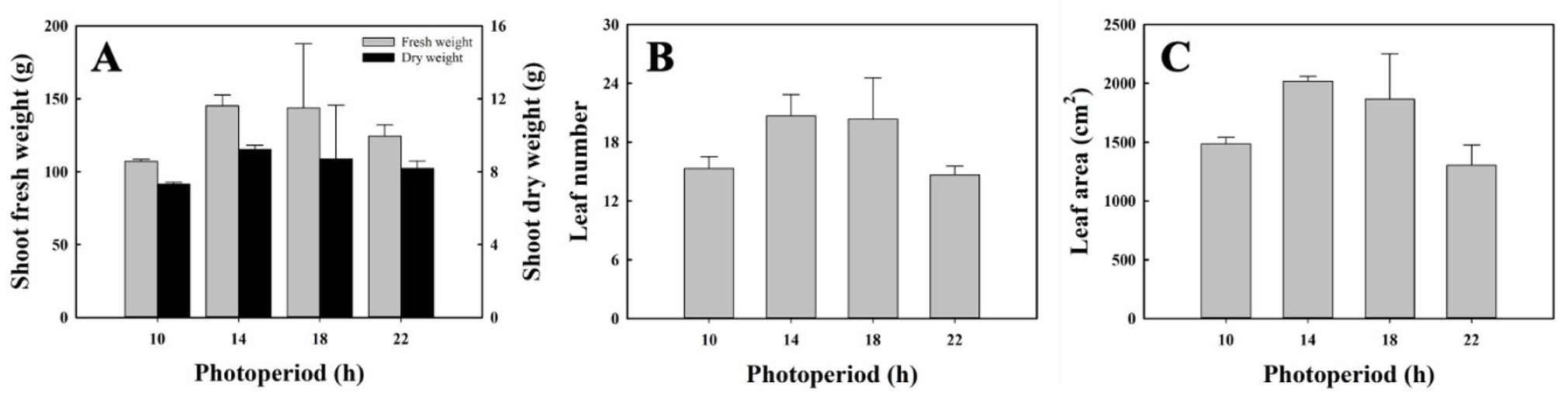
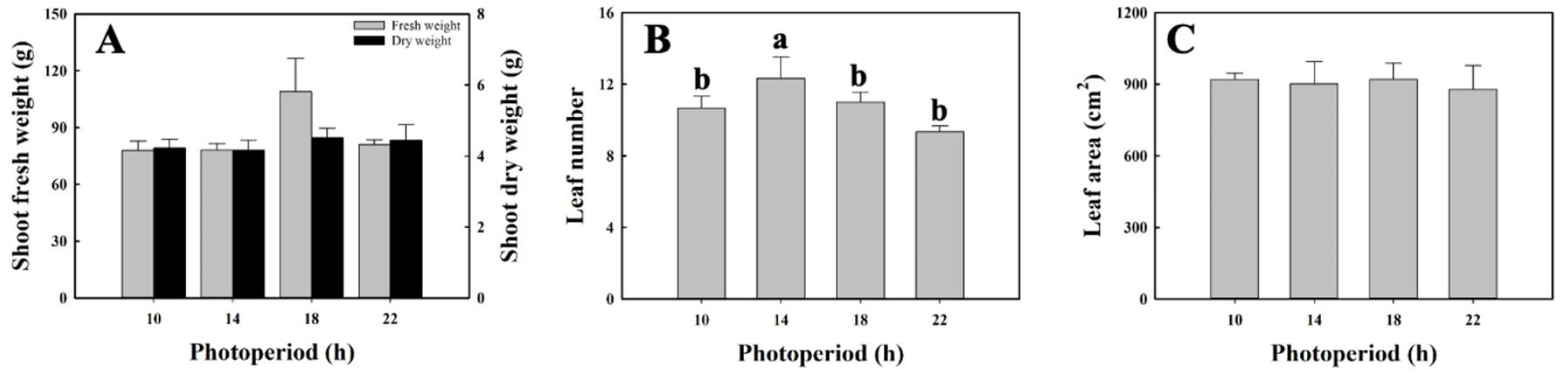
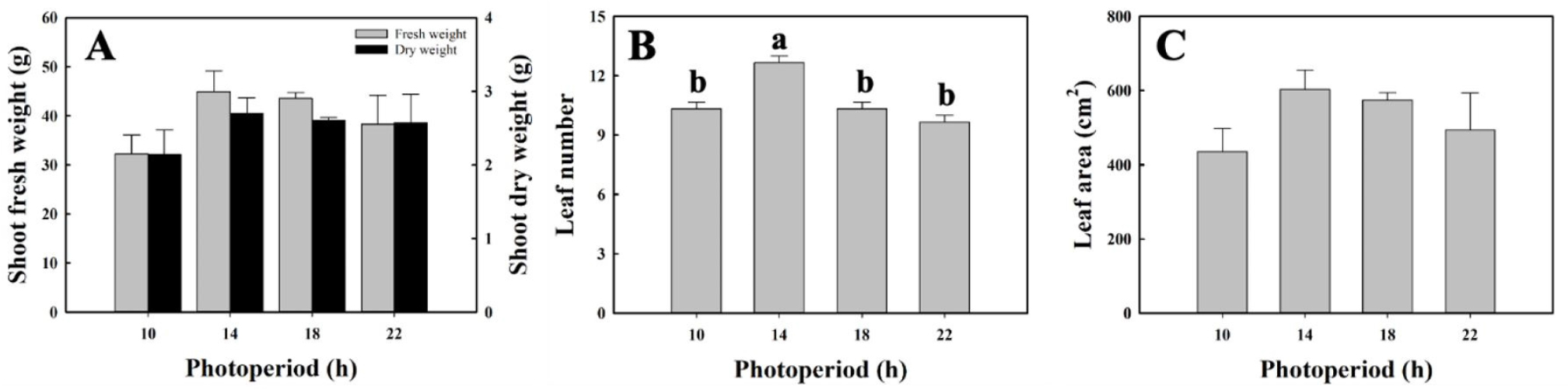
수확 후 갓, 적겨자, 케일을 관찰한 결과 갓의 경우 22h-127μmol·m-2·s-1 처리에서 지상부의 크기가 다른 처리구에 비해 작아지는 경향을 나타내었으며(Fig. 1), 적겨자도 22h-127μmol·m-2·s-1 처리에서 지상부의 생육이 저조하였다(Fig. 2). 그러나 케일은 모든 처리구에서 외관상 지상부 크기에 영향을 받지 않은 모습이었다(Fig. 3). 갓의 생육 분석 결과, 지상부 생체중과 건물중에서 14h-200μmol·m-2·s-1 처리가 다른 처리구들 사이에서 높은 평균값을 나타내었지만 다른 처리구와 비교하여 유의적인 차이는 나타나지 않았다(Fig. 4A). 14h-200μmol·m-2·s-1 처리에서 엽수의 경우 20.66개로 가장 개수가 많았고(Fig. 4B), 엽면적의 경우 2019.86cm3으로 가장 컸지만, 유의적인 차이는 없었다(Fig. 4C). 적겨자의 지상부 생체중과 건물중 경우 8h-155μmol·m-2·s-1 처리에서 108.97g과 4.5g으로 가장 높은 값을 나타내었지만, 유의적인 차이를 보이지 않았다(Fig. 5A). 엽수의 경우 14h-200μmol·m-2·s-1 처리가 10h-280, 18h-155, 22h-127μmol·m-2·s-1 처리보다 15.62, 12.12, 32.15%씩 유의적으로 증가하였다(Fig. 5B). 엽면적은 모든 처리구에서 유의적인 차이는 없었다(Fig. 5C). 케일의 지상부 생체중과 건물중에서 14h-200μmol·m-2·s-1 처리가 각각 44.91g과 2.69g으로 높은 평균값을 나타내었지만, 통계적 유의차는 없었다(Fig. 6A). 엽수에서 14h-200μmol·m-2·s-1 처리가 10h-280, 18h-155, 22h-127μmol·m-2·s-1 처리보다 22.58, 22.58, 31.03%로 유의하게 높은 개수를 나타내었다(Fig. 6B). 엽면적의 경우 14h-200μmol·m-2·s-1 처리에서 602.98cm2로 높은 평균값을 나타내었지만 다른 처리구들과의 유의적 차이가 없었다(Fig. 6C).
https://cdn.apub.kr/journalsite/sites/phpf/2022-031-04/N0090310419/images/phpf_31_04_19_F1.jpg
Fig. 1.

Leaf mustard (Brassica juncea (L.) Czern.) grown under different photoperiod and light intensity treatments in same DLI for 3 weeks after transplanting. Different letters (A, B, C, and D) mean 10h-280, 14h-200, 18h-155, 22h-127 μmol·m-2·s-1 treatment, respectively. Red line indicates 7 cm in length.
https://cdn.apub.kr/journalsite/sites/phpf/2022-031-04/N0090310419/images/phpf_31_04_19_F2.jpg
Fig. 2.

Red mustard (Brassica juncea L.) grown under different photoperiod and light intensity treatments in same DLI for 3 weeks after transplanting. Different letters (A, B, C, and D) mean 10h-280, 14h-200, 18h-155, 22h-127 μmol·m-2·s-1 treatment, respectively. Red line indicates 7 cm in length.

https://cdn.apub.kr/journalsite/sites/phpf/2022-031-04/N0090310419/images/phpf_31_04_19_F3.jpg
Fig. 3.

Kale (Brassica oleracea L. var. acephala (DC.) Alef.) grown under different photoperiod and light intensity treatments in same DLI for 3 weeks after transplanting. Different letters (A, B, C, and D) mean 10h-280, 14h-200, 18h-155, 22h-127 μmol·m-2·s-1 treatment. Red line indicates 7 cm in length.
https://cdn.apub.kr/journalsite/sites/phpf/2022-031-04/N0090310419/images/phpf_31_04_19_F4.jpg
Fig. 4.

Comparisons of shoot fresh weight and shoot dry weight (A), leaf number (B), leaf area (C) of leaf mustard (Brassica juncea (L.) Czern.) in the different photoperiod. The bars represent the means and the error bars indicate standard error (n = 3).

https://cdn.apub.kr/journalsite/sites/phpf/2022-031-04/N0090310419/images/phpf_31_04_19_F5.jpg
Fig. 5.

Comparisons of shoot fresh weight and shoot dry weight (A), leaf number (B), leaf area (C) red mustard (Brassica juncea L.) in the different photoperiod. The bars represent the means and the error bars indicate standard error (n = 3). Different letters at the top of bars indicate significant difference (p ≤ 0.05) by Duncan's multiple range test.
https://cdn.apub.kr/journalsite/sites/phpf/2022-031-04/N0090310419/images/phpf_31_04_19_F6.jpg
Fig. 6.

Comparisons of shoot fresh weight and shoot dry weight (A), leaf number (B), leaf area (C) of kale (Brassica oleracea L. var. acephala (DC.) Alef.) in the different photoperiod. The bars represent the means and the error bars indicate standard error (n = 3). Different letters at the top of bars indicate significant difference (p ≤ 0.05) by Duncan's multiple range test.

일반적으로 높은 광강도가 작물의 생장을 촉진하고 수확량을 증대시킨다고 알려졌지만(Dou와 Niu, 2020; Solovchenko 등, 2008), 동일한 DLI 조건에서는 20h-166μmol·m-2·s-1 처리가 12h-266μmol·m-2·s-1 처리보다 물냉이의 바이오매스 증대(Lam 등, 2021), 12h-200μmol·m-2·s-1 처리에서 16h-150μmol·m-2·s-1 처리로 갈수록 상추의 생장 증대(Mao 등, 2019), 10h-444μmol·m-2·s-1 처리보다 20-222μmol·m-2·s-1 처리로 미즈나와 상추의 더 많은 바이오매스를 생산하였다는 연구 결과가 보고되었다(Palmer와 van Iersel, 2020). 하루에 받는 총 광량이 같은 조건에서 낮은 광강도 및 긴 광주기가 작물의 바이오매스 증대에 영향을 끼친다는 점이 본 실험에서의 갓, 적겨자, 케일의 지상부 생체중 및 평균 건물중이 증가하는 결과와 유사하다. 이는 최적의 DLI 조건을 이용하면 식물공장에서의 전기 소모량을 낮출 수 있을 것임을 시사한다. 또한, 광주기가 길어질수록 작물의 엽록소 함량을 증가시키고 광합성 효율을 증대해 약한 광강도에서도 빛 에너지를 효과적으로 흡수시켜 생육 증가에 도움이 된다고 보고하였다(Mao 등, 2019). 그러나, 광강도의 감소는 광합성 효율을 감소시키고 탄소 균형에 영향을 주어 순광합성과 기공전도도가 감소했다는 연구 결과도 보고되었다(Feng 등, 2019; Lam 등, 2021; Su 등, 2014). 이러한 결과의 차이는 광질의 차이에서 오는 기공 개도 및 작물 부근의 미기상 조건에 따른 차이에 의한 것이라 사료되지만 엽록소 분석, 광합성 속도 및 기공 개폐 등 생장과 관련된 다양한 분석을 시행하고 이에 따른 세밀한 검증이 필요하다고 생각된다.

2. Glucosinolate 함량 분석

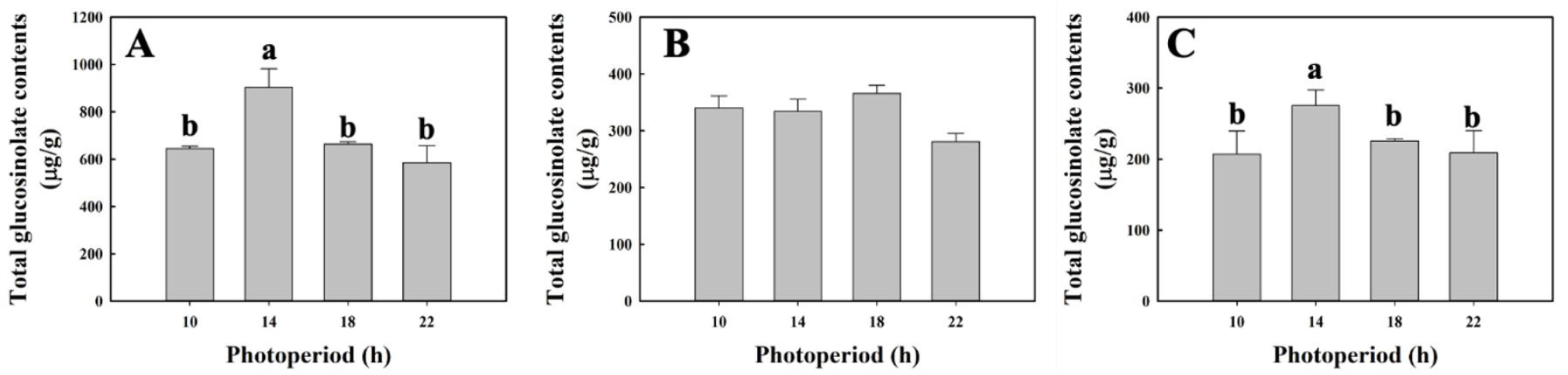
정식 후 같은 DLI 조건에서 각각의 광강도와 광주기 처리에서 3주 동안 갓, 적겨자, 케일의 GSLs 함량을 분석한 결과, 갓은 14h-200μmol·m-2·s-1 처리에서 902.73μmol·g-1으로 10h-280, 18h-155, 22h-127μmol·m-2·s-1 처리보다 39.95, 35.87, 54.04% 유의적으로 높았다(Fig. 7A). 적겨자는 18h-155μmol·m-2·s-1 처리가 365.74μmol·g-1으로 높게 나타났지만, 다른 처리구와 비교하여 유의적인 차이는 나지 않았다(Fig. 7B). 케일의 경우 14h-200μmol·m-2·s-1 처리에서 GSLs 함량이 10h-280, 18h- 155, 22h-127μmol·m-2·s-1 처리보다 32.97, 22.06, 31.79% 유의적으로 높았다(Fig. 7C). 광 환경에 따라 GSLs 함량이 변화되는데 광주기가 길어질수록 GSLs의 함량이 증대될 수 있다(Engelen-Eigles 등, 2006). 10h-280, 14h-200, 18h-155, 22h-127μmol·m-2·s-1 처리에서 갓과 케일의 경우 10h-280, 14h-200μmol·m-2·s-1 처리와 적겨자의 10h-280, 14h-200, 18h-155μmol·m-2·s-1 처리에서 유사한 결과를 보여주었지만, 모든 작물에서 22h-127μmol·m-2·s-1 처리에서 감소하는 경향을 보여주었다. 광주기가 길어지거나(Engelen-Eigles 등, 2006; Huseby 등, 2013) 광강도가 낮을 경우(Huang 등, 2021) GSLs의 함량이 증대된다고 보고와는 상반된 결과를 보였다.
https://cdn.apub.kr/journalsite/sites/phpf/2022-031-04/N0090310419/images/phpf_31_04_19_F7.jpg
Fig. 7.

Comparisons of the total glucosinolates (GSLs) content in leaf mustard (A), red mustard (B), kale (C) in the different photoperiod. The bars represent the means and the error bars indicate standard error (n = 3). Different letters at the top of bars indicate significant difference (p ≤ 0.05) by Duncan's multiple range test.

본 연구에서 갓과 케일에서는 10h-280μmol·m-2·s-1 처리에 비해 14h-200μmol·m-2·s-1 조합에서 유의적으로 높은 결과가 나타났다. 낮은 광강도와 긴 광주기 조건에서 GSLs 축적 증대에 긍정적으로 생각되며 같은 DLI 조건에서 다른 경향성을 보였다는 것은 유사한 생육 습성을 갖는 십자화과 식물이라도 종에 따라서 DLI 반응이 다르다는 것을 알 수 있다. 따라서 각 작물에 대한 최적의 DLI 조건 구명에 관한 연구가 더욱 필요하며 최소의 전력 소비량으로 최대의 효율을 내기 위해서는 광질에 대한 연구도 병행할 필요가 있다고 사료된다.


Acknowledgements

본 결과물은 농림축산식품부 및 과학기술정보통신부, 농촌진흥청의 재원으로 농림식품기술기획평가원과 재단법인 스마트팜연구개발사업단의 스마트팜다부처패키지혁신기술개발사업의 지원을 받아 연구되었음(421034-04).

References

1
Abidi F., T. Girault, O. Douillet, G. Guillemain, G. Sintès, M. Laffaire, H.B. Ahmed, S. Smiti, L. Huché‐Thélier, and N. Leduc 2013, Blue light effects on rose photosynthesis and photomorp hogenesis. Plant Biol 15:67-74. doi:10.1111/j.1438-8677.2012.00603.x 10.1111/j.1438-8677.2012.00603.x22686322
2
Amina H., M. Ahmad, G.R. Bhatti, M. Zafar, S. Sultana, M.A. Butt, S. Bahadur, I.U. Haq, M.A. Ghufran, and S. Ahmad 2020, Microscopic investigation of pollen morphology of Brassicaceae from Central Punjab‐Pakistan. Microsc Res Tech 83:446-454. doi:10.1002/jemt.23432 10.1002/jemt.2343231904169
3
Dou H., and G. Niu 2020, Plant responses to light. In T Kozai, G Niu, M Takagaki, eds., Plant Factory, 2nd Ed. Academic Press, pp 153-166. doi:10.1016/B978-0-12-816691-8.00009-1 10.1016/B978-0-12-816691-8.00009-1
4
Engelen-Eigles G., G. Holden, J.D. Cohen, and G. Gardner 2006, The effect of temperature, photoperiod, and light quality on gluconasturtiin concentration in watercress (Nasturtium officinale R. Br.). J Agric Food Chem 54:328-334. doi:10.1021/jf051857o 10.1021/jf051857o16417287
5
Falk K.L., J.G. Tokuhisa, and J. Gershenzon 2007, The effect of sulfur nutrition on plant glucosinolate content: Physiology and molecular mechanisms. Plant Biol 9:573-581. doi:10.1055/s-2007-965431 10.1055/s-2007-96543117853357
6
Feng L., M.A. Raza, Z. Li, Y. Chen, M.H.B. Khalid, J. Du, W. Liu, X. Wu, C. Song, and L. Yu 2019, The influence of light intensity and leaf movement on photosynthesis characteristics and carbon balance of soybean. Front Plant Sci 9:1952. doi:10.3389/fpls.2018.01952 10.3389/fpls.2018.0195230687355PMC6338029
7
Gao W., D. He, F. Ji, S. Zhang, and J. Zheng 2020, Effects of daily light integral and LED spectrum on growth and nutritional quality of hydroponic spinach. Agronomy. 10:1082. doi:10.3390/agronomy10081082 10.3390/agronomy10081082
8
Huang J.J., C. D'Souza, M.Q. Tan, and W. Zhou 2021, Light intensity plays contrasting roles in regulating metabolite compositions in choy sum (Brassica rapa var. parachinensis). J Agric Food Chem 69:5318-5331. doi:10.1021/acs.jafc.1c00155 10.1021/acs.jafc.1c0015533881316
9
Huseby S., A. Koprivova, B.-R. Lee, S. Saha, R. Mithen, A.-B. Wold, G.B. Bengtsson, and S. Kopriva 2013, Diurnal and light regulation of sulphur assimilation and glucosinolate biosynthesis in Arabidopsis. J Exp Bot 64:1039-1048. doi:10.1093/jxb/ers378 10.1093/jxb/ers37823314821PMC3580815
10
Jeong N.R., J.H. Chun, E.J. Park, Y.H. Lim, and S.J. Kim 2015, Variations of glucosinolates in kale leaves (Brassica oleracea var. acephala) treated with drought-stress in autumn and spring seasons. Korean J Agric Sci 42:167-175. (in Korean) doi:10.7744/cnujas.2015.42.3.167 10.7744/cnujas.2015.42.3.167
11
Jin W., D. Formiga Lopez, E. Heuvelink, and L.F.M. Marcelis 2022, Light use efficiency of lettuce cultivation in vertical farms compared with greenhouse and field. Food Energy Secur e391. doi:10.1002/fes3.391 10.1002/fes3.391
12
Kelly N., D. Choe, Q. Meng, and E.S. Runkle 2020, Promotion of lettuce growth under an increasing daily light integral depends on the combination of the photosynthetic photon flux density and photoperiod. Sci Hortic 272:109565. doi:10.1016/j.scienta.2020.109565 10.1016/j.scienta.2020.109565
13
Kim H.E., and K.B. Chin 2018, Antioxidant activities of brussels sprouts powder and its application to pork patties on the physicochemical properties and antioxidant activity during refrigerated storage. J Korean Soc Food Sci Nutr 47:733-741. (in Korean) doi:10.3746/jkfn.2018.47.7.733 10.3746/jkfn.2018.47.7.733
14
Lam V.P., J. Choi, and J. Park 2021, Enhancing growth and glucosinolate accumulation in watercress (Nasturtium officinale L.) by regulating light intensity and photoperiod in plant factories. Agriculture 11:723. doi:10.3390/agriculture11080723 10.3390/agriculture11080723
15
Lee G.G., H.J. Kim, S.J. Kim, J.W. Lee, and J.S. Park 2016, Increased growth by LED and accumulation of functional materials by florescence lamps in a hydroponics culture system for Angelica gigas. J Bio-Env Con 25:42-48. (in Korean) doi:10.12791/KSBEC.2016.25.1.42 10.12791/KSBEC.2016.25.1.42
16
Lee J.Y., S.R. Min, J.E. Jung, and H.R. Kim 2019, Effect of methyl jasmonate on the glucosinolate contents and whole genome expression in Brassica oleracea. J Plant Biotechnol 46:189-204. (in Korean) doi:10.5010/JPB.2019.46.3.189 10.5010/JPB.2019.46.3.189
17
Mao H., T. Hang, X. Zhang, and N. Lu 2019, Both multi-segment light intensity and extended photoperiod lighting strategies, with the same daily light integral, promoted Lactuca sativa L. growth and photosynthesis. Agronomy 9:857. doi:10.3390/agronomy9120857 10.3390/agronomy9120857
18
Mawlong I., M.S. Sujith Kumar, B. Gurung, K.H. Singh, and D. Singh 2017, A simple spectrophotometric method for estimating total glucosinolates in mustard de-oiled cake. Int J Food Prop 20:3274-3281. doi:10.1080/10942912.2017.1286353 10.1080/10942912.2017.1286353
19
Miękus N., K. Marszałek, M. Podlacha, A. Iqbal, C. Puchalski, and A.H. Świergiel 2020, Health benefits of plant-derived sulfur compounds, glucosinolates, and organosulfur compounds. Molecules 25:3804. doi:10.3390/molecules25173804 10.3390/molecules2517380432825600PMC7503525
20
Moon M.O., J.H. Tho, C.H. Kim, C.S. Kim, and M.H. Kim 2006, Unrecorded species from Korean flora: Maesa japonica (Thunb.) Moritzi & Zoll. [Maesaceae] and Cardamine tanakae Franch. & Sav. [Brassicaceae]. Korean J Plant Taxon 36:153-161. (in Korean) 10.11110/kjpt.2006.36.2.153
21
Nawaz H., M.A. Shad, and S. Muzaffar 2018, Phytochemical composition and antioxidant potential of Brassica. Brassica Germplasm Charact Breed Util 1:7-26. doi:10.5772/intechopen.76120 10.5772/intechopen.76120
22
Palmer S., and M.W. van Iersel 2020, Increasing growth of lettuce and mizuna under sole-source LED lighting using longer photoperiods with the same daily light integral. Agronomy 10:1659. doi:10.3390/agronomy10111659 10.3390/agronomy10111659
23
Solovchenko A.E., I. Khozin-Goldberg, S. Didi-Cohen, Z. Cohen, and M. Merzlyak 2008, Effects of light intensity and nitrogen starvation on growth, total fatty acids and arachidonic acid in the green microalga Parietochloris incisa. J Appl Phycol 20:245-251. doi:10.1007/s10811-007-9233-0 10.1007/s10811-007-9233-0
24
Su B., Y. Song, C. Song, L. Cui, T. Yong, and W. Yang 2014, Growth and photosynthetic responses of soybean seedlings to maize shading in relay intercropping system in Southwest China. Photosynthetica 52:332-340. doi:10.1007/s11099-014-0036-7 10.1007/s11099-014-0036-7
25
Xu W., N. Lu, M. Kikuchi, and M. Takagaki 2021, Continuous lighting and high daily light integral enhance yield and quality of mass-produced nasturtium (Tropaeolum majus L.) in plant factories. Plants 10:1203. doi:10.3390/plants10061203 10.3390/plants1006120334204820PMC8231634
26
Yan Z., D. He, G. Niu, Q. Zhou, and Y. Qu 2019, Growth, nutritional quality, and energy use efficiency of hydroponic lettuce as influenced by daily light integrals exposed to white versus white plus red light-emitting diodes. HortScience 54:1737-1744. doi:10.21273/HORTSCI14236-19 10.21273/HORTSCI14236-19
27
Zhang T., R. Liu, J. Zheng, Z. Wang, T.e. Gao, M. Qin, X. Hu, Y. Wang, S. Yang, and T. Li 2022, Insights into glucosinolate accumulation and metabolic pathways in Isatis indigotica Fort. BMC Plant Biol 22:1-20. doi:10.1186/s12870-022-03455-6 10.1186/s12870-022-03455-635193497PMC8862337
28
Zhang X., D. He, G. Niu, Z. Yan and J. Song 2018a, Effects of environment lighting on the growth, photosynthesis, and quality of hydroponic lettuce in a plant factory. Int JAgric Biol Eng 11:33-40. doi:10.25165/j.ijabe.20181102.3420 10.25165/j.ijabe.20181102.3240
29
Zhang Y., S. Xu, Y. Cheng, Z. Peng, and J. Han 2018b, Transcriptome profiling of anthocyanin-related genes reveals effects of light intensity on anthocyanin biosynthesis in red leaf lettuce. PeerJ 6:e4607. doi:10.7717/peerj.4607 10.7717/peerj.460729666761PMC5900932
페이지 상단으로 이동하기