


Introduction
Materials and Methods
1. Study area, production systems, and crop scope
2. Data sources and variable roles
3. Field observation boundary and data traceability
4. Calculation of same-year and conditional scenario estimates
Results
1. Data provenance and production-system context
2. Operational residue fractions and 2023 same-year scenario
3. Conditional 2024 harvested-area scenario
Discussion
Limitations and Future Work
Conclusions
Introduction
Horticultural crop residues generated during cultivation, harvest, sorting, and postharvest handling can be used for composting and anaerobic digestion, as substrate amendments, and as sources of value-added compounds. Tomato by-products have been investigated for lycopene, carotenoid, and dietary-fiber recovery, while paprika fruits, leaves, and other plant residues contain pigments, flavonoids, vitamins, and antioxidant compounds (Kim et al. 2011; Machmudah et al. 2012; Baek and Shin 2020; Gu et al. 2020; Ferrando et al. 2024). Before such pathways can be designed, however, the counted residue boundary and the locally available amount must be defined. Studies of Indonesian vegetable supply chains have also documented losses during postharvest handling and distribution, underscoring the need for location-specific data on residue availability (Eriyatno et al. 2024; Partnership for Action on Green Economy 2024).
Bogor Regency is suitable for a preliminary case-crop assessment because official crop statistics, farm-observation summaries, and data from a Korea-Indonesia ODA greenhouse platform are available for selected crops. Tomato, paprika, and large chili pepper were selected as contrasting case crops rather than as a representative sample of all horticultural production in Bogor. Their selection reflected the intersection of data availability, harvested area, project access, and potential resource use. Tomato is represented by both regional statistics and ODA greenhouse production logs; large chili pepper occupies a substantial regional area but has a more uncertain residue parameter; and paprika provides a protected-cultivation case but remains a minor regional crop.
Previous residue-utilization studies have primarily characterized composition or conversion potential, whereas local planning also requires transparent activity data and a clearly defined accounting boundary. In the available Bogor archive, the critical uncertainty is whether the reported residue fractions represent total crop biomass or only residues collected during routine operations. Accordingly, this study addressed two questions: (1) what quantities of operationally collectable residues can be estimated for the three case crops from the available project summaries and official statistics, and (2) what additional measurements are required to construct a defensible regional inventory?
Accordingly, the study documented the provenance and accounting boundary of the available residue fractions, defined them as provisional operational residue fractions (fop), and calculated a same-year 2023 screening estimate and a conditional 2024 harvested-area scenario. Korean greenhouse data were used solely to clarify differences in accounting boundaries and were not applied as coefficients for Bogor.
Materials and Methods
1. Study area, production systems, and crop scope
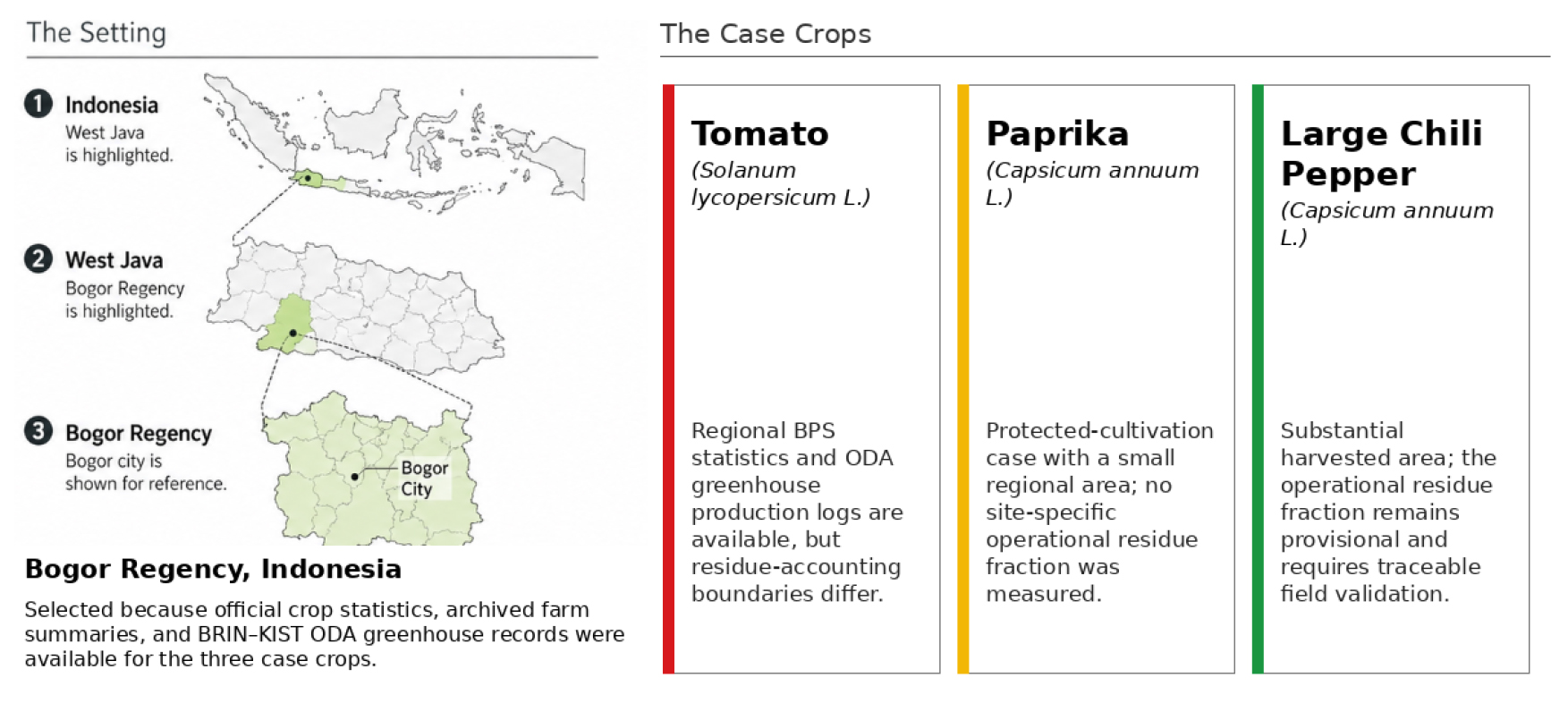
Fig. 1 summarizes the Bogor setting, ODA site, and three case crops. Most tomato production represented in the regional statistics occurs in open fields and uses predominantly determinate cultivars; container- or polybag-based cultivation is common, and crop stands can be highly heterogeneous even within the same nominal area. In contrast, the ODA site comprises Korean-style multi-span plastic greenhouses, including a 2.0-ha indeterminate-tomato unit and a 0.2-ha paprika unit. Local growers operate the facilities with continuing capacity-building support, so the resulting records are treated as project-site observations rather than representative regional means. BRIN, Indonesia's National Research and Innovation Agency, supports the characterization of local agricultural systems and database development and collaborates with KIST through this ODA cultivation research platform. The collaboration emphasizes local operation, training, standardized data logging, and lessons learned from earlier ODA implementation.
2. Data sources and variable roles
Four data groups were used, with their distinct analytical roles summarized in Table 1. (1) BPS Kabupaten Bogor statistics provided 2023 production and harvested area for the same-year activity baseline and 2024 harvested area for the conditional scenario (Badan Pusat Statistik Kabupaten Bogor 2024a, 2024b, 2025). (2) ODA greenhouse production logs provided site-specific marketable production and cultivated area for tomato and paprika, but not the residue fractions used in the regional calculations. (3) Archived summaries from the 2023–2025 farm-observation program provided crop-level residue fractions. (4) Shin et al. (2011) provided Korean greenhouse residue data solely for interpreting differences in accounting boundaries. Climate data and Korean national yield statistics were excluded from the analytical framework because they did not contribute directly to production (P), area (A), yield (Y), or fop.
Table 1
Data sources, variables, analytical roles, and limitations
| Data source | Variables contributed | Role in the analysis | Principal limitation |
| BPS Kabupaten Bogor, 2023 | P2023, A2023, Y2023 | Same-year regional activity baseline and normalized yield | Regional statistics; not farm-level experimental measurements |
| BPS Kabupaten Bogor, 2024 harvested-area table | A2024 | Conditional harvested-area scenario only | No corresponding 2024 production value was used; unchanged 2023 yield is assumed |
| BRIN-KISTODA greenhouse logs | Site production, cultivated area, site yield | Project-site context for indeterminate tomato and paprika | Specific Korean-style greenhouse; not representative of regional farms; no site-level fop |
|
Archived 2023–2025 farm-observation summaries | Crop-level fop | Provisional operational residue parameter | Raw crop by year numerator, denominator, area, sample distribution, and variance were unavailable |
| Shin et al. (2011) | Korean harvest-period stem, leaf, and fallen-fruit residue data | Boundary interpretation only | Different production system and non-equivalent accounting boundary; coefficients not transferred to Bogor |
3. Field observation boundary and data traceability
The farm-observation program included a program-wide total of 10 farms in each year from 2023 through 2025; this did not represent 10 independent farms for each crop. The available archive contains crop-level summary fractions of 7.5% for tomato, 4.3% for paprika, and 11% for large chili pepper, but no traceable crop-by-year table of individual farms, observation dates, farm area, plant density, raw residue fresh weight, or corresponding marketable yield. The field protocol specified that residues be weighed immediately after collection, but the archived summaries do not indicate whether each marketable-yield denominator was measured directly or obtained from grower records. Consequently, the farm-level numerator and denominator cannot be independently reconstructed from the reported fractions.
For this assessment, fop was defined as the ratio of operationally collected fresh residue to the corresponding marketable-yield value recorded in the project summary. The numerator included in-season pruned stems and leaves, non-marketable fruits, fallen fruits, and grading losses. Roots and soil-contaminated materials were outside the accounting boundary, and end-of-cycle removal of the standing whole plant was not consistently documented. Accordingly, fop should not be interpreted as a total aboveground biomass ratio or converted into a whole-plant biomass value on a per-plant basis. The records cover on-farm and project-site collection, grading, and handling streams; no separate sampling was conducted at wholesale or retail distribution stages.
4. Calculation of same-year and conditional scenario estimates
For the primary 2023 screening estimate, the regional amount of operational residue was calculated from same-year production and the provisional operational residue fraction:
Yield (Y2023 = P2023/A2023) and the operational coefficient (Cop = Y2023 × fop) were reported only as normalized expressions and do not represent independent measurements. The secondary 2024 harvested area scenario was calculated as follows:
This scenario assumes that the 2024 yield was equal to the 2023 BPS yield and that fop remained constant across farms, production systems, and yield levels. It is therefore a conditional scenario rather than an observed 2024 inventory. Calculations used unrounded source values; no inferential statistical tests or confidence intervals were applied.
The ODA tomato and paprika yields were calculated by dividing project production logs by the corresponding greenhouse areas and were used only to describe the project sites. The regional scenarios were based on BPS activity data because the ODA facilities represent specific greenhouse systems rather than regional production. Shin et al. (2011) collected stem, leaf, and fallen-fruit residues at harvest from intensive Korean greenhouse farms and reported biomass yield per unit area. Because end of cycle standing-plant removal was not consistently documented in the Bogor archive, the Korean coefficients represent a non-equivalent accounting boundary and were not used to calculate direct coefficient ratios, validate the Bogor fractions, or establish numerical benchmarks.
Results
1. Data provenance and production-system context
Table 1 summarizes the variables supplied by each source. The 2023 BPS tomato baseline was 6,434.2 t from 347.50 ha (18.52 t·ha-1), whereas the 2024 ODA indeterminate tomato greenhouse produced 38.8 t from 2.0 ha (19.4 t·ha-1). The numerical similarity between these yields does not justify use of a common residue coefficient because the regional baseline is dominated by heterogeneous, predominantly determinate open-field production, whereas the ODA value represents a single Korean-style protected system.
For paprika, the 2023 BPS baseline was 1.8 t from 0.30 ha (6.0 t·ha-1), and the 2024 ODA greenhouse produced 0.72 t from 0.20 ha (3.6 t·ha-1). The lower ODA yield is presented as a project-site observation rather than a regional validation result. Because the greenhouse is locally operated within an ongoing capacity-building program, the available data do not support attribution of the yield difference to any single factor.
For large chili pepper, the 2023 BPS baseline was 2,946.4 t from 268.43 ha (10.98 t·ha-1 on a fresh-fruit basis). No ODA greenhouse observation was available for this crop.
2. Operational residue fractions and 2023 same-year scenario
The archived fop values were 7.5% for tomato, 4.3% for paprika, and 11% for large chili pepper (Table 2). Applying these fractions to the corresponding 2023 BPS yields produced normalized operational coefficients of 1.389, 0.258, and 1.207 t·ha-1 FM, respectively. These coefficients represent the defined operational residue stream and exclude any assumed mass for unrecorded end of cycle whole plant removal.
Table 2
Yield context, operational residue fractions, and normalized scenario coefficients
Applying the fractions to same-year 2023 production yielded operational residue screening amounts of 482.6 t FM for tomato, 0.08 t FM for paprika, and 324.1 t FM for large chili pepper (Table 3). These values are scenario estimates derived from aggregated fop values, not sums of recoverable crop-by-year farm measurements.
Table 3
Same-year 2023 operational residue screening amounts and conditional 2024 harvested-area scenarios
The 2023 scenario is R2023 = P2023 × fop. The conditional 2024 scenario is R2024,scenario = A2024 × Y2023 × fop and assumes that the 2024 yield was equal to the 2023 BPS yield. Scenario values were calculated from unrounded source values. Neither scenario represents a sum of recoverable farm-level raw measurements.
3. Conditional 2024 harvested-area scenario
The reported 2024 harvested areas were 327.10 ha for tomato, 3.00 ha for paprika, and 318.83 ha for large chili pepper. Under the explicit assumption that 2024 yields were equal to the 2023 BPS yields, the conditional operational residue scenarios were 454.2, 0.77, and 385.0 t FM, respectively (Table 3).
The paprika area increased from 0.30 ha in the 2023 BPS baseline to 3.00 ha in the 2024 harvested-area table. Because corresponding 2024 production was not part of the dataset used here, the tenfold area difference was not interpreted as confirmed expansion with unchanged productivity. The 2024 paprika value is included solely to illustrate the consequence of the stated area and yield assumption.
The estimated quantities in both scenarios indicate that tomato and large chili pepper should be prioritized in a new, traceable measurement campaign. Paprika remains useful as a greenhouse demonstration crop, but the available evidence is insufficient to characterize it as a regional residue stream.
Discussion
The principal contribution of this study is a transparent appraisal of what can and cannot be inferred from the available field summaries, rather than a definitive residue inventory for Bogor. Defining the three ratios as fop clarifies an important accounting-boundary issue: they represent materials entering routine collection and handling streams, not the total fresh biomass of each crop.
Because end of cycle standing-plant removal was not consistently recorded in the Bogor archive, the tomato fop cannot be converted into a whole plant stem and leaf mass on a per-plant basis. By contrast, Shin et al. (2011) collected stem, leaf, and fallen-fruit residues at harvest from intensive greenhouse farms and reported biomass yield per unit area. A direct biological comparison is not methodologically valid because the Bogor and Korean coefficients represent different residue categories and non-equivalent accounting boundaries.
Production-system heterogeneity further limits direct comparison. Most tomato production in Bogor is open-field and predominantly determinate, often involving container or polybag cultivation with uneven stand establishment and management. The Polbangtan Bogor ODA site is a Korean-style multi-span greenhouse in which indeterminate tomato is grown by local operators receiving continuing training. Similarities or differences in average yield across these systems do not, by themselves, establish equivalence in plant biomass, crop duration, pruning intensity, or residue-collection practices. Once equivalent residue categories and activity data are measured under a common protocol, Korean protected-horticulture performance may serve as a long-term technological reference for ODA greenhouse development; until then, the coefficients reported here should not be used as numerical benchmarks.
For resource recycling planning, the scenario values should be interpreted as provisional lower-bound screening parameters. Tomato and large chili pepper warrant priority in a follow-up campaign because of their substantial regional activity levels, whereas paprika is better suited to a site scale demonstration. Selection of utilization pathways should await standardized measurements of moisture content, dry matter, contamination, and residue category composition; paprika residues, in particular, may require pesticide and elemental safety screening (Ju et al. 2026).
Limitations and Future Work
The principal limitation is the absence of traceable farm-level raw data. Crop by year residue fresh weights, marketable yield denominators, farm areas, crop-specific sample counts, and repeated-farm identifiers could not be recovered from the archive. The scenarios assume that a single aggregated fop applies across farms and production levels; the 2024 scenario additionally assumes that the 2023 yield remained unchanged. These limitations preclude statistical inference, validation of per-plant biomass, and claims of a complete regional inventory.
Future observations should assign a unique identifier to each farm and crop cycle and record cultivar, determinate or indeterminate growth habit, open-field or protected conditions, container or soil cultivation, planted and harvested area, plant density, measurement date, and marketable yield. Fresh weight should be recorded separately for in-season pruned stems and leaves, rejected or fallen fruits, grading losses, and the standing whole plant removed at crop termination. Paired measurements of dry weight, moisture content, C/N ratio, nutrients, pesticide residues, and heavy metals would then support both a defensible residue coefficient and the selection of composting, anaerobic digestion, substrate amendment, or value-recovery pathways.
Conclusions
This case-crop assessment reports provisional operational residue fractions of 7.5% for tomato, 4.3% for paprika, and 11% for large chili pepper. On a same-year 2023 basis, these fractions correspond to screening amounts of 482.6, 0.08, and 324.1 t FM, respectively. The conditional 2024 harvested-area scenario yields 454.2, 0.77, and 385.0 t FM, respectively, only under the stated assumption that 2023 yields remained unchanged. Because end of cycle whole plant biomass and traceable farm-level numerator and denominator records were not consistently available, these values should not be interpreted as total biological residue ratios or as a statistically validated regional inventory. The study provides a transparent baseline for designing a complete field-measurement protocol, prioritizing tomato and large chili pepper and using the BRIN-KIST ODA greenhouse platform as a controlled site for future validation.