


Introduction
Materials and Methods
1. Field experiment
2. Experimental plot and honeybee colonies
3. Flower thinning and bee acclimatization
4. Fruit measurements
5. Statistical analysis
Results
1. Flowering Overlap
2. Fruit weight and dimensions
3. Fruit-weight distribution and marketable yield
4. Seed number per fruit
5. Physicochemical fruit quality
Discussion
Conclusion
Introduction
Kiwifruit (Actinidia spp.) is a widely cultivated temperate and subtropical fruit crop. The genus Actinidia includes approximately 50-60 species and substantial infraspecific diversity, with its center of diversity in China (Li et al. 2002; Huang and Ferguson 2007). Commercial production is dominated by green- and yellow-fleshed cultivars derived principally from A. chinensis var. deliciosa and A. chinensis var. chinensis (Ferguson 2015). Kiwifruit is functionally dioecious and therefore requires pollen transfer from male to female flowers. Because both staminate and pistillate flowers lack nectar, they are relatively unattractive to honeybees compared with competing floral resources (Tacconi et al. 2016; Sáez et al. 2019). Fruit mass and quality are closely associated with seed set, and inadequate pollination can reduce fruit weight, uniformity, and marketable yield (Hopping 1976; González et al. 1998; Broussard et al. 2021). The effective pollination period is short because stigma receptivity and ovule longevity decline rapidly after anthesis (Hopping and Jerram 1979; Ferguson 1991). Commercial orchards therefore use several assisted-pollination approaches, including mechanical dusting, liquid pollen spraying, and other targeted pollen-application methods (González et al. 1998; Sáez et al. 2019; Oh et al. 2022). Although these approaches can improve pollen delivery, they require viable pollen, specialized equipment, and substantial labor during a narrow flowering window (Castro et al. 2021; David et al. 2022). Managed honeybees provide a potential labor-saving alternative, and previous field studies have shown that their effectiveness depends on colony strength and density, hive placement, flowering overlap, and the spatial density and arrangement of male vines (Testolin 1991; Howpage et al. 2001; Goodwin et al. 2013; David et al. 2022). In Korean gold kiwifruit, managed honeybees have also shown measurable pollination effects, although cultivar-specific evidence remains limited (Lee et al. 2019). Few studies have directly compared pollinizer combinations under managed honeybee pollination in ‘Haegeum’. Accordingly, this study evaluated managed honeybee pollination with ‘Okcheon’, ‘Haesun’, and the combined ‘Haesun + Okcheon’ pollinizer treatment under uniform flower thinning, using artificial hand pollination as a reference. The objective was to determine whether complementary male flowering periods could support seed formation, fruit size, and internal quality and thereby provide a practical basis for reducing reliance on artificial hand pollination.
Materials and Methods
1. Field experiment
1.1 Pollinizer cultivars and flowering phenology
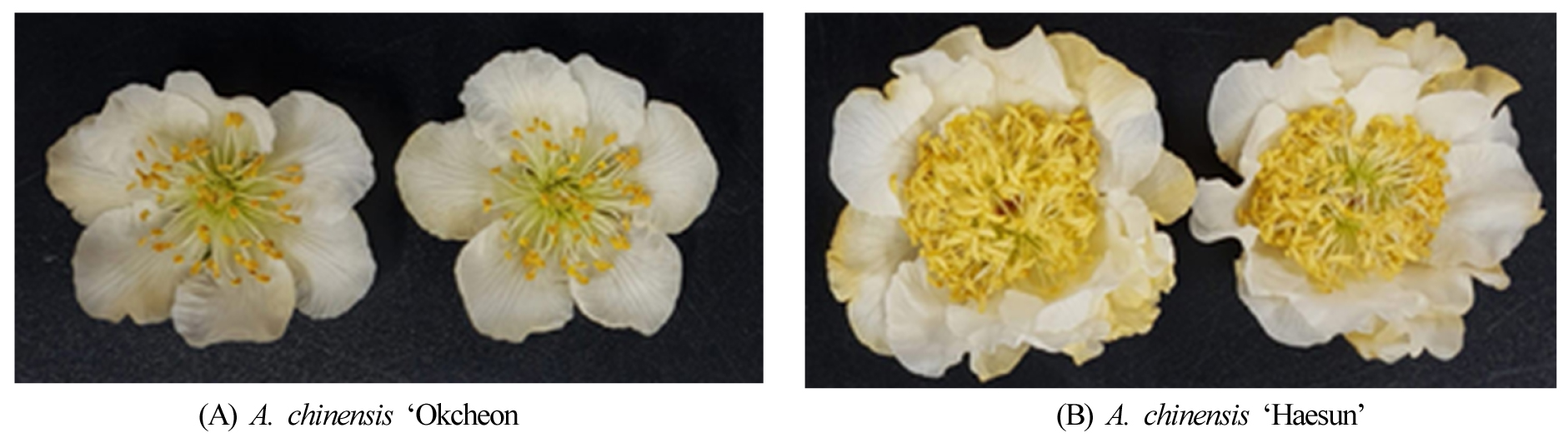
Two male A. chinensis pollinizer cultivars, ‘Okcheon’ and ‘Haesun’, were evaluated for their effects on seed formation and fruit quality in the yellow-fleshed female cultivar ‘Haegeum’. ‘Okcheon’ generally reached first bloom two to four days earlier than ‘Haegeum’ and was therefore treated as an early-flowering pollinizer. ‘Haesun’ initiated flowering three to five days later than ‘Okcheon’ and one to three days after ‘Haegeum’, representing a mid- to late-flowering pollinizer. Observed flowering and full-bloom dates for the three cultivars from 2021 to 2023 are summarized in Table 1, and representative flowers of the male cultivars are shown in Fig. 1. The dual-pollinizer treatment was designed to test whether the combination of early- and late-flowering male cultivars could extend pollen availability across the female flowering period. In the ‘Haesun + Okcheon’ treatment, both male cultivars were present simultaneously and pollen transfer to receptive female flowers was mediated by managed honeybees.
Table 1
Flowering and full-bloom dates of male pollinizers and the female cultivar ‘Haegeum’ from 2021 to 2023
| Cultivarz | Flowering | Full bloom | ||||
| 2021 | 2022 | 2023 | 2021 | 2022 | 2023 | |
| ‘Okcheon’ (♂) | May 3 | May 9 | May 9 | May 10 | May 13 | May 13 |
| ‘Haesun’ (♂) | May 7 | May 13 | May 13 | May 12 | May 17 | May 17 |
| ‘Haegeum’ (♀) | May 10 | May 12 | May 12 | May 12 | May 15 | May 15 |
2. Experimental plot and honeybee colonies
A field experiment was conducted from May 12 to June 3, 2022, in three open-field gold kiwifruit orchards (6,600 m2, 3,300 m2, and 3,300 m2) in Gogum-myeon, Wando-gun, Jeollanam-do, Korea. The female cultivar was ‘Haegeum’ (A. chinensis), and the male pollinizers were ‘Haesun’ and ‘Okcheon’. In the single-pollinizer treatments, one male cultivar was grafted at one position, whereas both cultivars were grafted at two positions on the same vine in the dual-pollinizer treatment. At pollination, the average branch length of the pollinizer cultivars was approximately 1.5 m. Each honeybee (A. mellifera) colony comprised three combs and approximately 7,500 worker bees. Colonies were stocked at a density of one colony per 1,650 m2 (approximately 6 colonies ha-1). Fruit-weight distributions for artificial hand pollination and the dual-pollinizer honeybee treatment were also assessed in 2023; seed number and physicochemical quality were evaluated only in 2022. Because the treatments were not independently replicated at the orchard level, individual fruits were considered subsamples, and treatment comparisons were interpreted cautiously.
3. Flower thinning and bee acclimatization
Prior to the initiation of bee pollination, flower thinning was performed to optimize pollination efficiency and subsequent fruit set. Gold kiwifruit typically produces an excessive number of flower buds; therefore, only one or two buds per inflorescence were retained, while the remaining buds were removed at the bud stage. This practice was intended to reduce competition among flowers and to ensure that the retained buds received sufficient resources for proper development. Honeybee colonies were introduced two days before the onset of female anthesis, which allowed the bees to acclimate to the orchard environment and enhanced their foraging activity and pollination effectiveness.
4. Fruit measurements
4.1 Fruit weight and marketable-fruit proportion
At harvest, fruit weight was measured using an electronic balance (AFP-210 L, Adam Equipment, Oxford, UK). Fruit-weight distributions were determined from 300 fruits per treatment. Fruit weighing at least 80 g was classified as marketable for the present analysis. The number and percentage of fruit at or above and below this threshold were calculated for each treatment.
4.2 Fruit dimensions
Fruit length and maximum diameter were measured in 300 fruits per treatment using a digital caliper (HG00962A, Powerfix Profi+, USA). The fruit-shape index was calculated as length divided by diameter.
4.3 Soluble solids and titratable acidity
Soluble solids concentration (SSC, °Brix) and titratable acidity (TA) were measured in juice prepared from six biological replicates, each consisting of 15 fruits. SSC was determined using a digital refractometer (Atago PR-101, Atago Co., Ltd., Tokyo, Japan). TA was determined by potentiometric titration with 0.01 M NaOH to pH 8.2 and expressed as citric acid equivalents (%).
4.4 Seed number per fruit
The number of fully developed seeds per fruit was counted after harvest as an indicator of pollination effectiveness. Fruits were opened longitudinally, and seeds were separated from the flesh and counted for the subsample used in the statistical analysis.
4.5 Dry matter content
Dry matter content (DMC, %) was determined at harvest from a 1-cm-thick equatorial slice. Each slice was divided into four sections, and fresh weight was recorded immediately using an electronic balance (AFP-210 L, Adam Equipment, Oxford, UK). Samples were oven-dried at 65°C for 72 h, and DMC was calculated as (dry weight / fresh weight) × 100. Each biological replicate comprised five quarter-sections, each obtained from a different fruit, and six biological replicates were evaluated per treatment.
5. Statistical analysis
Data were analyzed using R software (version 4.3.1; R Core Team 2023). Residual normality was evaluated with the Shapiro-Wilk test, and homogeneity of variance was assessed with Levene’s test. When one-way analysis of variance (ANOVA) indicated differences among treatments (p < 0.05), means were separated using Tukey’s honestly significant difference test at α = 0.05. Fruit weight and fruit dimensions were summarized from 300 fruits per treatment. Physicochemical quality variables were evaluated from six biological replicates, and seed number was analyzed from 505 fruits in total. Data are presented as mean ± SD unless otherwise stated. Because orchard-level treatment replication was unavailable, inferential results represent fruit-level comparisons within the study orchards and should not be interpreted as replicated orchard-level treatment effects.
Results
1. Flowering Overlap
‘Okcheon’ flowered earlier than ‘Haegeum’ in all three years. In 2021, full bloom occurred on May 10 for ‘Okcheon’ and on May 12 for both ‘Haegeum’ and ‘Haesun’. In 2022, full bloom occurred on May 13 for ‘Okcheon’, May 15 for ‘Haegeum’, and May 17 for ‘Haesun’, and the full-bloom dates in 2023 matched those in 2022 (Table 1). Thus, the two male cultivars bracketed the ‘Haegeum’ full-bloom date in 2022 and 2023, whereas ‘Haesun’ coincided with ‘Haegeum’ full bloom in 2021.
2. Fruit weight and dimensions
Fruit weight, length, diameter, and shape ratio at harvest are summarized in Table 2. Mean fruit weight was 93.0 ± 17.8 g under ‘Okcheon’, 90.8 ± 15.6 g under ‘Haesun’, 90.7 ± 12.7 g under the dual-pollinizer ‘Haesun + Okcheon’ treatment, and 99.3 ± 10.9 g under artificial hand pollination. Artificial hand pollination produced the highest descriptive mean fruit weight, whereas the three honeybee-mediated treatments had similar means (approximately 91-93 g). Fruit length (59.4-61.9 mm), diameter (50.9-52.6 mm), and shape ratio (length:diameter approximately 1.2) were also similar among treatments. These values are descriptive because treatments were not independently replicated at the orchard level.
Table 2
Fruit weight and dimensions at harvest by pollination treatment in 2022
| Pollination method | Weight (g) | Length (mm) | Diameter (mm) | Shape (L/D)z |
| ‘Okcheon’ | 93.0 ± 17.8 | 59.9 ± 3.6 | 51.0 ± 3.6 | 1.2 |
| ‘Haesun’ | 90.8 ± 15.6 | 59.4 ± 3.4 | 51.1 ± 2.3 | 1.2 |
| ‘Haesun + Okcheon’ | 90.7 ± 12.7 | 60.2 ± 1.1 | 50.9 ± 0.5 | 1.2 |
| Artificial hand | 99.3 ± 10.9 | 61.9 ± 0.2 | 52.6 ± 0.7 | 1.2 |
3. Fruit-weight distribution and marketable yield
Fruit-weight distributions for all four pollination treatments in 2022 are shown in Fig. 2, and artificial hand pollination and the dual-pollinizer honeybee treatment are compared across 2022 and 2023 in Fig. 3. In 2022, artificial hand pollination produced a mean fruit weight of 99.3 ± 10.9 g, with 292 of 300 fruits (97.3%) meeting the ≥80-g study threshold. The dual-pollinizer honeybee treatment produced a mean fruit weight of 90.7 ± 12.7 g, with 245 of 300 fruits (81.7%) meeting the threshold. The single-pollinizer honeybee treatments had lower proportions: 226 of 300 fruits (75.3%) for ‘Haesun’ and 227 of 300 fruits (75.7%) for ‘Okcheon’. In 2023, 96.7% of artificially pollinated fruit and 90.3% of dual-pollinizer honeybee-pollinated fruit met the threshold (Fig. 3B). The smaller difference in 2023 indicates that seasonal conditions may influence the relative fruit-size distributions of the two pollination approaches.
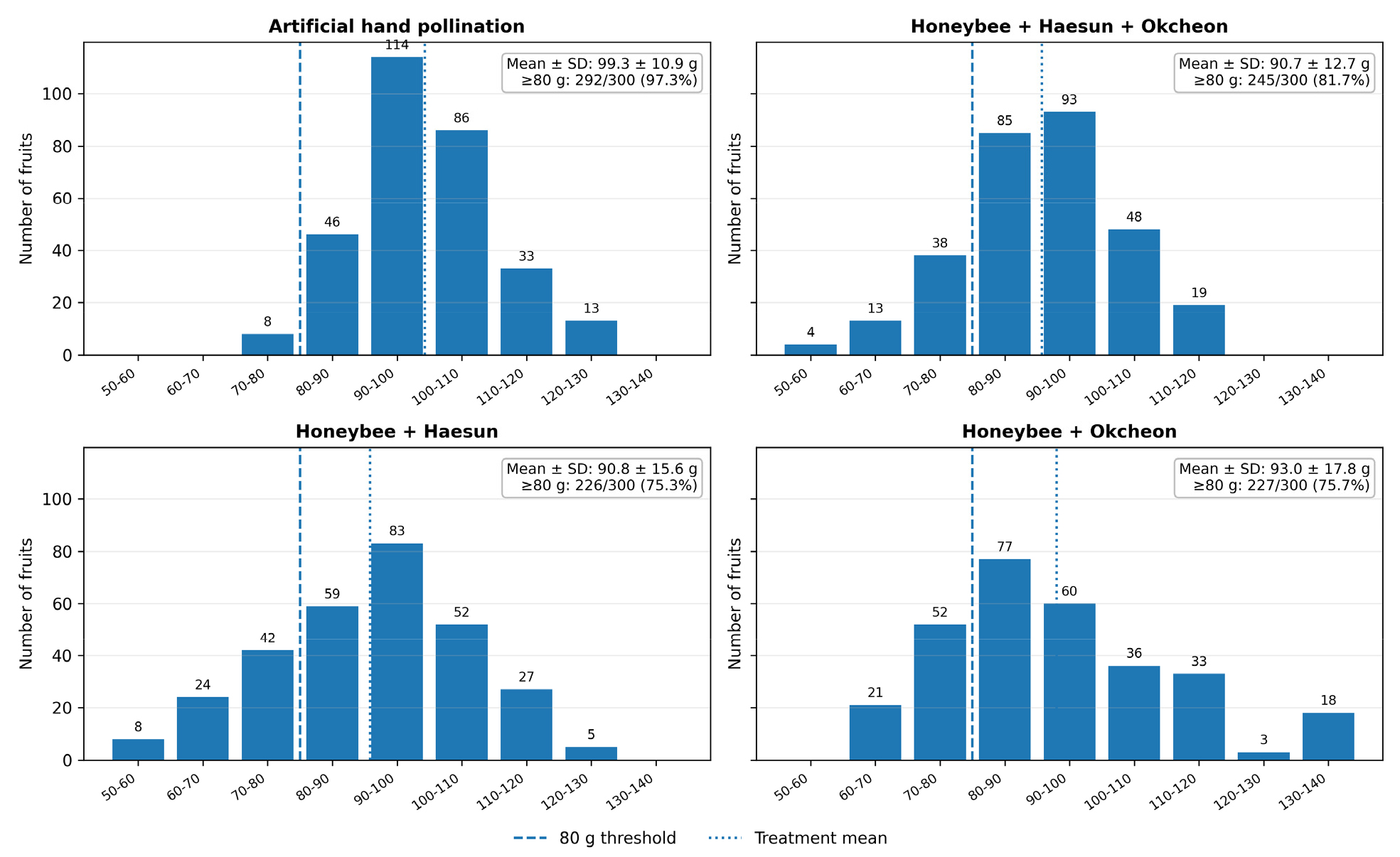
Fig. 2
Fruit-weight distributions of gold kiwifruit ‘Haegeum’ under four pollination treatments in 2022 (n = 300 fruits per treatment). Bars show counts in 10-g classes; dashed and dotted lines indicate the study-defined 80-g threshold and treatment mean, respectively. Values are descriptive because orchard-level treatment replication was unavailable
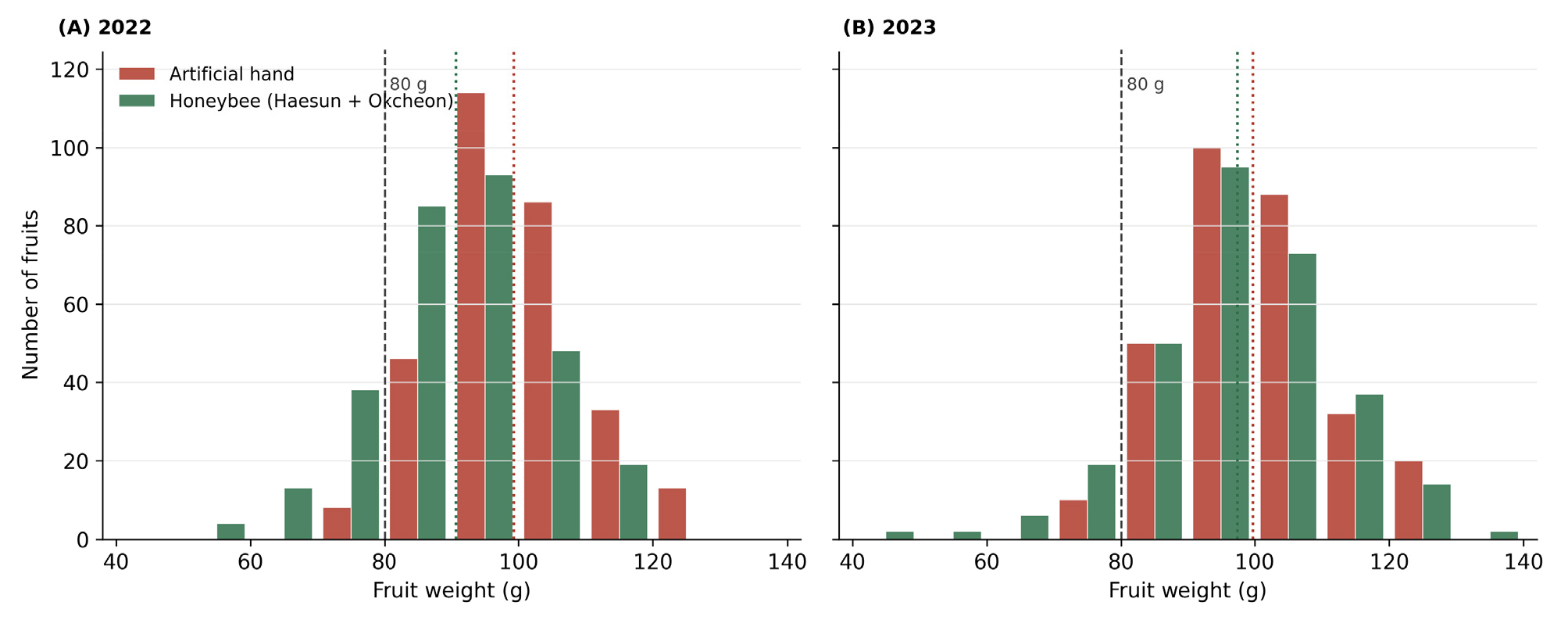
Fig. 3
Fruit-weight distributions of ‘Haegeum’ under artificial hand pollination and dual-pollinizer (‘Haesun + Okcheon’) honeybee pollination in 2022 and 2023 (n = 300 fruits per treatment per year). Dashed and dotted lines indicate the study-defined 80-g threshold and treatment means, respectively. Values are descriptive because orchard-level treatment replication was unavailable
4. Seed number per fruit
The fruit-level one-way ANOVA indicated differences in mean seed number among pollination treatments (F3,501 = 5.8, p < 0.01; Table 3). ‘Haesun’ (824 ± 68) and the dual-pollinizer ‘Haesun + Okcheon’ treatment (822 ± 113) formed the highest-seed statistical group (a), whereas ‘Okcheon’ (785 ± 97) and artificial hand pollination (766 ± 135) formed group b. Because orchard-level replication was unavailable, these differences should be interpreted as within-orchard fruit-level contrasts.
Table 3
Physicochemical quality and seed number by pollination treatment in 2022
5. Physicochemical fruit quality
Internal quality parameters were similar among treatments (Table 3). Flesh hue value (approximately 101-102), soluble solids concentration (approximately 8.8-8.9 °Brix), dry matter content (approximately 17.1-18.1%), and titratable acidity (approximately 1.4-1.5%) did not differ in the fruit-level analysis. Thus, managed honeybee pollination maintained the measured internal quality attributes at levels comparable to artificial hand pollination under the conditions of this study.
Discussion
Managed honeybee pollination supported seed formation in A. chinensis ‘Haegeum’ while maintaining the measured internal fruit-quality attributes. The seed numbers observed under ‘Haesun’ and ‘Haesun + Okcheon’ were at least comparable to those obtained with artificial hand pollination in the fruit-level analysis. This result is consistent with previous evidence that managed bees can provide effective pollen transfer in kiwifruit when colony density, hive placement, and flowering synchrony are appropriate (Howpage et al. 2001; Goodwin et al. 2013; David et al. 2022; Abbate et al. 2023). However, honeybee visitation frequency and pollen deposition were not measured in the present study, so the biological mechanism cannot be confirmed directly. Pollinizer phenology was an important feature of the treatment design. ‘Okcheon’ flowered earlier than ‘Haegeum’ and ‘Haesun’ later, so their combination broadened the period during which male flowers were available. Such temporal overlap is especially relevant in kiwifruit because stigma receptivity and ovule viability decline within a short period after anthesis (Hopping and Jerram 1979; Ferguson 1991). The higher seed number in the dual-pollinizer treatment may therefore reflect improved temporal pollen availability. The study did not identify pollen parentage or test pollen-pistil compatibility directly; consequently, the contribution of pollen-source diversity remains a hypothesis rather than a demonstrated mechanism. The density and spatial arrangement of male vines should also be considered in future replicated trials (Testolin 1991). Artificial hand pollination produced a higher descriptive mean fruit weight and a larger proportion of fruit above the study-defined 80-g threshold in 2022. Nevertheless, the dual-pollinizer honeybee treatment reached 81.7% in 2022 and 90.3% in 2023, suggesting that managed honeybees can produce a high proportion of marketable-sized fruit under favorable orchard conditions. Similar studies have reported that honeybee pollination can support fruit set, seed number, and fruit quality, although outcomes vary with cultivar, season, orchard structure, and pollinator management (Lee et al. 2019; David et al. 2022). The 80-g value used here is an analytical threshold for this dataset and should not be interpreted as a universal commercial grade. Flower thinning to one or two buds per inflorescence was applied uniformly across all treatments. This standardization reduced a potential source of treatment imbalance, but the study was not designed to estimate the independent effect of thinning or its interaction with pollination method. Likewise, the narrower fruit-weight dispersion observed in some treatments cannot be attributed to thinning without a factorial comparison. Economic benefits also remain unquantified: managed honeybee pollination may reduce hand-pollination labor, but colony rental, hive management, pollen availability, and seasonal risk must be included in a dedicated cost analysis before wholesale substitution can be recommended.
These findings should be interpreted in light of several limitations. The most important limitation is the absence of independent orchard-level replication for each pollination treatment. Individual fruits were subsamples within orchards rather than independent treatment replicates; therefore, the ANOVA and letter groupings describe fruit-level contrasts and do not establish orchard-level causal effects. Detailed seed and physicochemical measurements were obtained in only one season (2022) and one production area, although fruit-weight distributions were compared over two seasons. In addition, honeybee visitation, pollen deposition, pollen parentage, colony strength over time, and weather during the effective pollination period were not quantified. The artificial-pollination pollen source and its viability should also be reported explicitly in future experiments. Replicated multi-site trials that include bee-behavior measurements, additional male cultivars, and economic variables are needed before broad recommendations can be made. Despite these constraints, the study provides useful field observations for designing a more rigorous comparison of managed honeybee and artificial pollination in Korean gold kiwifruit orchards.
Conclusion
Managed honeybee (A. mellifera) pollination maintained seed formation and internal fruit quality in gold kiwifruit ‘Haegeum’ under the conditions of this field study. ‘Haesun’ alone and the ‘Haesun + Okcheon’ combination formed the highest-seed group in the fruit-level analysis, and the complementary flowering periods of the two male cultivars provide a plausible agronomic basis for extending pollen availability. Artificial hand pollination produced a higher descriptive mean fruit weight and a greater proportion of fruit above the study-defined 80-g threshold in 2022, whereas the dual-pollinizer honeybee treatment reached 81.7% in 2022 and 90.3% in 2023. Soluble solids, dry matter, titratable acidity, and flesh color were comparable among treatments. Managed honeybees combined with complementary pollinizers therefore represent a promising labor-saving option, but the current data do not establish orchard-level treatment effects or economic superiority. Independent orchard replication, direct measurement of bee activity and pollen deposition, and formal cost analysis are required before the approach can be recommended as a full replacement for artificial hand pollination.