

Introduction
Materials and Methods
1. Soil composition and Sr treatment
2. Cultivation and growth assessment
3. Statistical analysis
Results and Discussion
1. Effect of strontium concentration and organic matter content on growth of Chinese cabbage
2. Effects on biomass accumulation based of Sr concentration and organic matter content
3. Changes in chlorophyll content under different strontium concentrations with varying organic matter content
Introduction
Strintuim (Sr) is a naturally occurring alkaline earth metal exists in both radioactive and stable forms. Among these, the radioactive isotope strontium-90 (90Sr) is produced as a byproduct of nuclear fission and has a relatively long half-life of approximately 28.8 years (White and Broadley, 2003). Due to its chemical similarity to calcium, The high environmental mobility of 90Sr, resulting from its chemical similarity to calcium, facilitates its transfer through soil, groundwater, and living organisms, and is thus recognized as a critical factor in ecological and human health risk assessments (Veresoglou et al., 1996).
In the environment, 90Sr can be absorbed by plant roots and translocated to aerial tissues, potentially disrupting calcium dependent physiological functions and causing various forms of phytotoxicity. Consequently, the transfer of Sr from soil to plants is an important consideration in environmental radiological safety (With et al., 2021). Variation in strontium uptake and plant physiological responses is largely determined by the plant species, developmental stage, and the chemical and physical properties of the soil environment (Chen et al., 2022). At high concentrations, Sr has been reported to inhibit germination and plant growth, and to induce tissue damage and chromosomal abnormalities (Meena et al., 2013).
However, due to the radiological hazard of 90Sr, experimental research typically uses stable, non-radioactive Sr compounds, such as strontium chloride hexahydrate (SrCl2· 6H2O), to safely simulate Sr uptake and physiological effects in plants (Liu et al., 2023; Sowa et al., 2014; Zhang et al., 2020). Recent studies have also highlighted the potential of soil organic matter amendments to reduce the bioavailability and phytotoxicity of Sr in contaminated soils (Boyer et al., 2018; Camps et al., 2003; Liu et al., 2023), largely due to the immobilization of Sr2+ ions through adsorption and complexation (Rafferty et al., 1994).
Although numerous studies have examined the risks of strontium accumulation in edible crops and the resulting implications for human exposure, direct quantification of Sr concentrations in plant tissues was not conducted in the present study. Instead, the present research aimed to evaluate the effects of different Sr concentrations and soil organic matter content on the growth and physiological characteristics of Chinese cabbage (Brassica rapa subsp. pekinensis), a major leafy vegetable in Korea. In this study, SrCl2·6H2O was employed as a surrogate for 90Sr to evaluate key plant growth parameters and chlorophyll content, with the aim of assessing Sr-induced phytotoxicity and elucidating the mitigating effects of organic matter.
The results of this study will contribute to the understanding of plant responses to strontium stress and inform the development of organic matter-amended remediation approaches for soils impacted by radionuclide contamination.
Materials and Methods
1. Soil composition and Sr treatment
A soil-based experiment was conducted to evaluate the growth and physiological responses of Chinese cabbage (Brassica rapa cv. ‘Dano Spring Cabbage’, Jinheung Co., Gyeonggi-do, Korea) under varying levels of non-radioactive Sr and soil organic matter. The study was carried out in a glasshouse (28.8 m × 3.0 m, total area 86.4 m2) at Pusan National University (Miryang, Korea), where the average ambient temperature was maintained at 20°C. Plants were cultivated individually in 1/5,000a Wagner pots placed on elevated benches. The growth medium consisted of peat moss (PRO-MOSS TBK, Premier Tech Horticulture, Canada), commercial bed soil (Seonghwa Co., Korea), and organic fertilizer (Hyeondaeteugsan Co., Korea), mixed at ratios to achieve organic matter levels of 5%, 10%, or 15% (v/v) (Table 1). For each treatment, the components were mixed according to the specified ratios, and each pot was filled with an equal volume of the resulting soil mixture. Sr was applied in the form of strontium chloride hexahydrate (SrCl2·6H2O, CAS No. 10025-70-4; Daejung Chemicals, Korea), which shares ionic behavior similar to 90Sr but is non-radioactive, ensuring safe laboratory handling. Four Sr concentrations were applied to soil in powder form: 0, 50, 100, and 200 mg·kg-1. Soils were filled to over 80% of the pot volume and stabilized for two weeks before planting.
Table 1.
Composition ratio of soil mixture according to organic matter content.
|
Organic matter content (%) |
Peatmoss (v) |
Organic Fertilizer (v) |
Bed soil (v) |
Mixing ratioz (v/v/v) |
|
5 10 15 |
2 2 2 |
12 24 36 |
240 240 240 |
2 : 12 : 240 2 : 24 : 240 2 : 36 : 240 |
The experimental design was a 3 × 4 factorial with three levels of organic matter (5%, 10%, 15%) and four Sr concentrations, arranged in a randomized complete block design (RCBD) with three replicates. Each replicate included six plants. The control treatment was soil mixture with no Sr application at each organic matter level.
2. Cultivation and growth assessment
Cultivation practices followed the standard guidelines of the Rural Development Administration (RDA), Korea. Growth and physiological characteristics were measured at 50 and 80 days after Sr treatment. Growth indices included plant height, number of leaves, leaf length, leaf width, root length, leaf area, fresh weight, and dry weight. Chlorophyll content was evaluated using a SPAD meter (SPAD-502, Minolta Co., Japan).
Leaf area was measured using a portable leaf area meter (LI-3000, LI-COR, USA), and SPAD values were averaged from three readings taken from the middle of the third true leaf. Plant height and root length were measured from the base to the tip of the respective plant part. Dry weight was determined after oven-drying at 70°C for 24 hours.
3. Statistical analysis
Data were analyzed using the SAS software (version 9.4, SAS Institute Inc., Cary, NC, USA). Means were compared using the duncans multiple range test at the 5% significance level.
Results and Discussion
1. Effect of strontium concentration and organic matter content on growth of Chinese cabbage
In this study, strontium chloride hexahydrate (SrCl2·6H2O) was used as a non-radioactive surrogate for Sr-90 to assess the interactive effects of strontium (Sr) concentration and soil organic matter (OM) content on the growth of Chinese cabbage (Brassica rapa subsp. pekinensis) (Table 2, Fig. 1).
Table 2.
Effects of Sr treatment with varying organic matter content on number of leaves, leaf area, leaf length, leaf width, plant height, root length for various growth state of Chinese cabbage at 20°C in greenhouse.
|
Organic matter (%) |
Sr conc. (mg·kg-1) |
No. of leaves |
Leaf area (cm2) | Leaf |
Plant height (cm) |
Root length (cm) | |
|
Length (cm) |
Width (cm) | ||||||
| Growth stage: 50 days | |||||||
| 5 | 50 | 16.5 aby | 2,009.9 ab | 11.9 a | 7.6 a | 26.0 ab | 28.8 ab |
| 100 | 14.5 bc | 1,920.9 b | 18.5 a | 9.5 a | 23.5 ab | 39.3 ab | |
| 200 | 14.0 c | 1,926.5 b | 11.6 a | 8.1 a | 28.9 ab | 32.2 ab | |
| Untreated | 16.0 a | 2,222.5 a | 15.1 a | 9.9 a | 24.7 ab | 25.5 ab | |
| 10 | 50 | 17.5 ab | 2,008.8 ab | 14.1 a | 9.3 a | 25.6 b | 28.2 b |
| 100 | 15.5 bc | 1,697.1 b | 10.9 a | 8.0 a | 22.0 b | 19.4 b | |
| 200 | 14.0 c | 1,655.1 b | 13.7 a | 9.6 a | 23.6 b | 14.7 b | |
| Untreated | 18.0 a | 2,154.0 a | 12.0 a | 9.5 a | 24.9 b | 24.8 b | |
| 15 | 50 | 16.5 ab | 2,089.1 ab | 14.8 a | 10.0 a | 27.0 a | 28.4 a |
| 100 | 15.5 bc | 1,630.9 b | 11.6 a | 8.3 a | 26.7 a | 23.4 a | |
| 200 | 14.0 c | 1,758.8 b | 15.0 a | 11.0 a | 25.3 a | 27.6 a | |
| Untreated | 18.5 a | 2,281.7 a | 10.5 a | 7.7 a | 27.6 a | 31.7 a | |
| Significance | |||||||
| Organic matter (A) | NSz | NS | NS | NS | * | ** | |
| Sr concentration (B) | * | * | NS | NS | NS | NS | |
| A × B | NS | NS | NS | NS | NS | NS | |
| Growth stage: 80 days | |||||||
| 5 | 50 | 24.5 b | 2,812.4 a | 9.8 bc | 7.3 abcd | 28.9 a | 22.0 a |
| 100 | 25.0 b | 2,728.0 b | 5.4 c | 4.9 cd | 27.1 a | 20.9 a | |
| 200 | 23.5 b | 2,685.2 b | 7.8 bc | 6.4 bcd | 28.8 a | 22.0 a | |
| Untreated | 27.5 b | 2,836.3 a | 18.1 ab | 11.0 ab | 30.3 a | 24.5 a | |
| 10 | 50 | 24.5 b | 2,881.8 a | 23.9 a | 12.2 a | 29.2 a | 22.8 a |
| 100 | 24.5 b | 2,217.5 b | 11.8 bc | 7.9 abcd | 25.9 a | 19.6 a | |
| 200 | 26.5 b | 2,596.0 b | 4.6 c | 3.9 d | 26.6 a | 22.2 a | |
| Untreated | 28.0 b | 3,140.6 a | 14.8 abc | 10.4 abc | 29.3 a | 26.9 a | |
| 15 | 50 | 28.5 a | 2,915.0 a | 5.7 c | 8.2 abcd | 29.0 a | 26.0 a |
| 100 | 28.0 a | 2,583.2 b | 5.4 c | 3.6 d | 25.3 a | 25.3 a | |
| 200 | 26.5 a | 2,564.7 b | 7.2 bc | 5.9 bcd | 29.4 a | 24.1 a | |
| Untreated | 28.4 a | 3,001.4 a | 10.8 bc | 8.8 abcd | 28.3 a | 26.5 a | |
| Significance | |||||||
| Organic matter (A) | * | NS | NS | NS | NS | NS | |
| Sr concentration (B) | NS | * | * | NS | NS | NS | |
| A × B | NS | NS | * | * | NS | NS | |
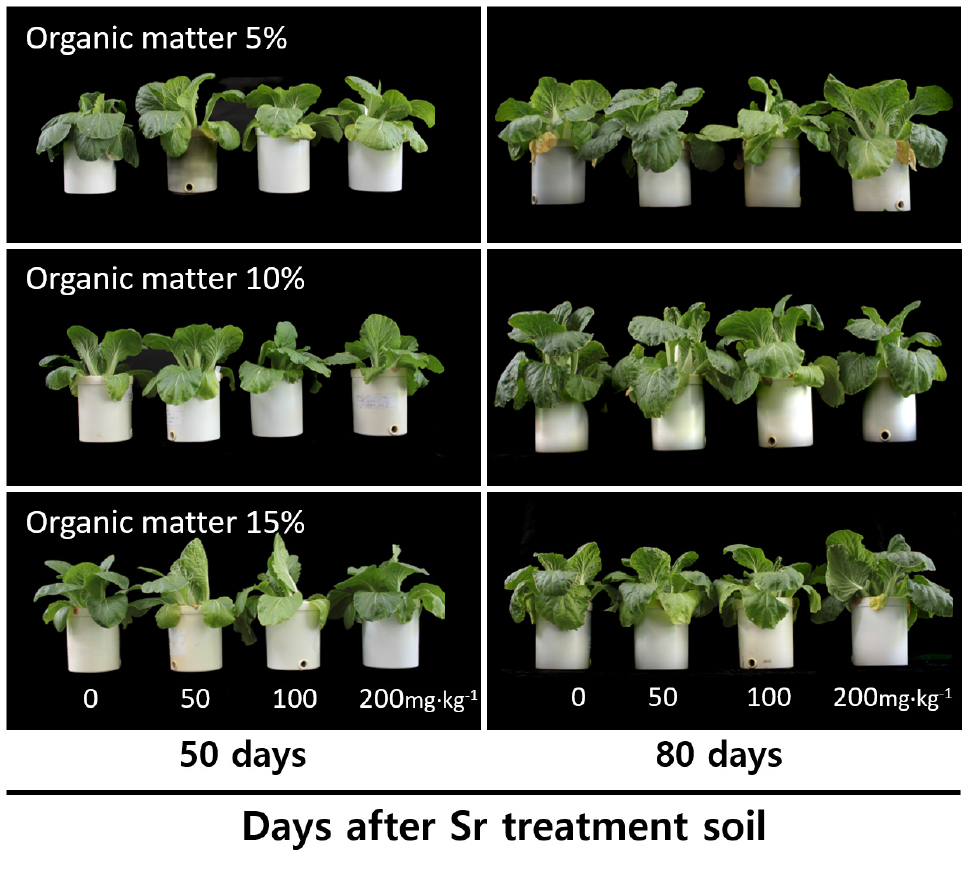
At 50 days after transplanting, most growth parameters including plant height, leaf length, and leaf width did not exhibit a clear concentration dependent response to Sr or OM. The only exceptions were number of leaves and total leaf area, which differed significantly by Sr concentration (p < 0.05). Specifically, the control group (no Sr added) consistently had the greatest number of leaves and the largest leaf area across all OM levels consistent with previous studies (Chao et al., 2024; Liu et al., 2023). Statistical analysis also revealed that the interaction between Sr concentration and organic matter content was not significant for most growth parameters at this stage, indicating the absence of a combined effect.
A closer look at the data shows that, under high organic matter conditions (15% OM), exposure to 200 mg·kg-1 Sr led to the largest reductions in both number of leaves and leaf area (24% and 22% decrease, respectively, compared to the control). These declines exceeded the reductions observed at the same Sr concentration in low-OM soils (5% OM), implying that increased organic matter did not effectively mitigate the negative impact of high Sr exposure. In other words, OM content did not provide a strong buffering capacity against Sr-induced growth inhibition at this stage. Soil organic matter can influence how strongly strontium binds in soils and plant uptake. Higher OM may slightly increase Sr retention in soil or slow plant uptake, though mitigative effects on growth toxicity are limited and species or condition dependent (Abdel-Sabour, 2022; Margon et al., 2013).
Interestingly, for some parameters, particularly at the lowest Sr concentration (50 mg·kg-1), there was a slight, non-significant promotion of growth compared to the control, especially in plant height and certain leaf measurements. This modest stimulatory effect at low Sr is in line with previous studies, which report that low doses of Sr can sometimes enhance growth or physiological processes in plants under certain stress conditions (Zhang et al., 2020).
By 80 days after transplanting, the data revealed a moderate shift. Here, the interaction between Sr and organic matter became significant, but only for leaf length and leaf width. Even so, no consistent or interpretable pattern emerged from this result, and most treatments did not show a predictable growth response based on Sr or OM levels. The most pronounced difference was observed at 10% OM, where the highest Sr treatment (200 mg·kg-1) produced dramatically smaller leaves (mean leaf length and width of 4.6 cm and 3.6 cm, respectively) relative to the control (14.8 cm and 10.4 cm). In summary, the results demonstrate that at later growth stages (80 days), the Sr and OM interaction is statistically significant for certain parameters, but does not translate into a clear pattern of growth mitigation or enhancement. These findings highlight the nuanced role of Sr in plant growth. Low levels may occasionally promote growth, but increasing concentrations clearly inhibit vegetative development, and the capacity of organic matter to ameliorate Sr toxicity appears limited under the tested conditions.
2. Effects on biomass accumulation based of Sr concentration and organic matter content
Fresh and dry biomass accumulation in Chinese cabbage was analyzed at both 50 and 80 days after SrCl2·6H2O application across varying levels of organic matter (Table 2).
Table 3.
Effects of Sr treatment with varying organic matter content on fresh weight and dry weight for various growth stages of Chinese cabbage at 20°C in greenhouse.
|
Organic matter (%) |
Sr conc. (mg·kg-1) |
Fresh weight (g/plant) |
Dry weight (g/plant) | |||||
| Shoot | Root | Total | Shoot | Root | Total | |||
| Growth stage: 50 days | ||||||||
| 5 | 50 | 140.1 ay | 3.4 a | 143.5 a | 7.2 a | 0.4 a | 7.6 a | |
| 100 | 98.9 b | 3.2 a | 102.1 b | 6.4 b | 0.3 a | 6.7 a | ||
| 200 | 79.9 b | 2.5 a | 82.4 b | 6.2 b | 0.2 a | 6.4 a | ||
| Untreated | 135.2 a | 4.9 a | 140.1 a | 8.0 a | 0.4 a | 8.4 a | ||
| 10 | 50 | 123.3 a | 2.8 a | 135.4 a | 7.5 a | 0.3 a | 7.8 a | |
| 100 | 94.9 b | 1.5 a | 96.4 b | 6.1 b | 0.1 a | 6.2 a | ||
| 200 | 63.4 b | 1.5 a | 64.9 b | 6.3 b | 0.2 a | 6.4 a | ||
| Untreated | 134.5 a | 3.7 a | 138.7 a | 8.1 a | 0.4 a | 8.4 a | ||
| 15 | 50 | 142.6 a | 2.9 a | 145.5 a | 8.2 a | 0.3 a | 8.5 a | |
| 100 | 100.4 b | 2.2 a | 102.5 b | 5.6 b | 0.2 a | 5.7 a | ||
| 200 | 118.4 b | 2.2 a | 120.6 b | 5.0 b | 0.4 a | 5.4 a | ||
| Untreated | 146.5 a | 3.9 a | 150.3 a | 8.9 a | 0.4 a | 9.2 a | ||
| Significance | ||||||||
| Organic matter (A) | NSz | NS | NS | NS | NS | NS | ||
| Sr concentration (B) | * | NS | * | * | NS | NS | ||
| A × B | NS | NS | NS | NS | NS | NS | ||
| Growth stage: 80 days | ||||||||
| 5 | 50 | 230.5 ab | 5.7 a | 236.2 ab | 12.3 a | 0.5 a | 12.8 a | |
| 100 | 232.1 b | 3.7 a | 235.8 b | 13.4 a | 0.2 a | 13.6 a | ||
| 200 | 247.3 b | 4.8 a | 251.1 b | 11.6 a | 0.5 a | 11.1 a | ||
| Untreated | 290.3 a | 6.5 a | 296.8 a | 13.4 a | 0.5 a | 13.9 a | ||
| 10 | 50 | 261.4 ab | 4.8 a | 266.2 ab | 14.9 a | 0.3 a | 15.1 a | |
| 100 | 187.8 b | 3.6 a | 191.4 b | 12.5 a | 0.2 a | 12.8 a | ||
| 200 | 245.6 b | 5.2 a | 250.7 b | 15.7 a | 0.3 a | 16.1 a | ||
| Untreated | 263.7 a | 5.1 a | 268.8 a | 13.6 a | 0.4 a | 14.0 a | ||
| 15 | 50 | 280.9 ab | 6.5 a | 287.4 ab | 17.5 a | 0.4 a | 17.9 a | |
| 100 | 269.7 b | 7.3 a | 277.0 b | 13.7 a | 0.4 a | 14.1 a | ||
| 200 | 265.7 b | 8.7 a | 274.4 b | 12.6 a | 0.4 a | 13.0 a | ||
| Untreated | 298.3 a | 7.7 a | 306.0 a | 13.6 a | 0.5 a | 14.0 a | ||
| Significance | ||||||||
| Organic matter (A) | * | NS | NS | NS | NS | NS | ||
| Sr concentration (B) | * | NS | * | NS | NS | NS | ||
| A × B | NS | NS | NS | NS | NS | NS | ||
At 50 days, increasing Sr concentration significantly decreased shoot and total fresh weight. In the 5% organic matter treatment, the 200 mg·kg-1 Sr treatment resulted in a total fresh weight of 82.4 g/plant, representing a 41.2% reduction compared to the control (140.1 g/plant). Dry weight followed a similar trend across all organic matter treatments, showing consistent declines with increasing Sr concentration. Notably, the 100 mg·kg-1 Sr treatment with 10% organic matter resulted in the lowest shoot dry weight (6.34 g/plant), suggesting that Sr availability and uptake may vary depending on the organic matter level.
In contrast, the 15% organic matter treatment maintained higher fresh weight but relatively lesser dry weight than other organic matter treatments indicating lesser biomass accumulation despite the organic matter addition.
At 80 days, Sr toxicity continued to significantly affect plant biomass. In the 5% organic matter treatment, shoot fresh weights ranged from 230.5 to 290.3 g/plant, with the 50 mg·kg-1 Sr treatment showing a 20.5% reduction compared to the control, which is greater reduction than in higher concentrations. Under the 10% organic matter condition, the lowest fresh weight was observed in the 100 mg·kg-1 Sr treatment (187.8 g/plant), indicating intensified growth suppression at moderate Sr levels.
However, the 15% organic matter treatment preserved relatively high shoot fresh weight (265.7 g/plant) even under the 200 mg·kg-1 Sr treatment, confirming the continued buffering effect of organic matter. Dry weight also decreased with increasing Sr concentrations, following a trend similar to that of fresh weight. Although the negative effects of Sr were mitigated to an extent at 80 days, high Sr concentrations still caused significant growth inhibition. This may be due to either an acquired tolerance of the plants to Sr stress or the cumulative accumulation of Sr within plant tissues over time.
Overall, higher Sr concentrations significantly reduced both fresh and dry biomass in Chinese cabbage, with more pronounced effects under lower organic matter conditions. These results align with previous reports that Sr2+ competes with Ca2+ transport in plants, leading to disrupted physiological functions and impaired growth (Dasch et al., 2006; Liu et al., 2023; Veresoglou et al., 1996). The mitigating effect of organic matter is attributed to its capacity to adsorb Sr2+, reduce its solubility and limit its plant availability.
Supporting earlier studies (Boyer et al., 2018; Camps et al., 2003), the addition of organic matter can immobilize Sr through adsorption to colloids and clay minerals or transformation into insoluble complexes, thereby reducing plant uptake. In this study, higher organic matter content (15%) consistently alleviated Sr toxicity and limited the decline in biomass across both growth stages. Particularly at 80 days, improved root development and prolonged interaction with organic matter likely contributed to reduced Sr uptake and translocation.
These findings provide quantitative evidence that organic matter amendments can buffer the phytotoxic effects of Sr and enhance crop tolerance in Sr-contaminated soils. Using SrCl2·6H2O as a non-radioactive surrogate for Sr-90, this study presents a practical experimental model to simulate radioactive contamination and evaluate mitigation strategies through organic matter management.
3. Changes in chlorophyll content under different strontium concentrations with varying organic matter content
To assess the effect of Sr concentration and soil organic matter content on photosynthetic activity, relative chlorophyll content was measured using SPAD values at 50 and 80 days after transplanting (Table 4).
Table 4.
Effect of Sr treatment with varying organic matter content on chlorophyll content for various growth stages of Chinese cabbage at 20°C in greenhouse.
|
Organic matter (%) | Sr concentration (mg·kg-1) |
Chlorophyll (SPAD unit) |
| Growth stage : 50 days | ||
| 5 | 50 | 42.4 ay |
| 100 | 37.3 a | |
| 200 | 38.4 a | |
| Untreated | 43.7 a | |
| 10 | 50 | 34.4 a |
| 100 | 36.0 a | |
| 200 | 38.7 a | |
| Untreated | 40.8 a | |
| 15 | 50 | 37.2 a |
| 100 | 37.2 a | |
| 200 | 35.6 a | |
| Untreated | 41.9 a | |
| Significance | ||
| Organic matter (A) | NSz | |
| Radionuclide concen. (B) | NS | |
| A × B | NS | |
| Growth stage : 80 days | ||
| 5 | 50 | 40.0 a |
| 100 | 35.3 a | |
| 200 | 40.0 a | |
| Untreated | 40.1 a | |
| 10 | 50 | 39.4 a |
| 100 | 39.8 a | |
| 200 | 40.8 a | |
| Untreated | 40.6 a | |
| 15 | 50 | 39.9 a |
| 100 | 40.2 a | |
| 200 | 39.6 a | |
| Untreated | 40.5 a | |
| Significance | ||
| Organic matter (A) | NS | |
| Radionuclide concen. (B) | NS | |
| A × B | NS | |
At both 50 and 80 days growth stage, SPAD values varied slightly across Sr treatments and organic matter levels, but no statistically significant differences were observed. No clear dose-dependent trend of Sr on chlorophyll content was observed. At 80-day growth stage average SPAD values for the 5%, 10% and 15% organic matter treatments were 38.7, 40.2 and 40.0, respectively. These results suggest that Sr toxicity did not significantly impair photosynthetic pigment levels under the conditions tested.
The absence of significant differences in SPAD values may be attributed to the fact that Sr does not directly participate in the biosynthetic pathway of chlorophyll (Chao et al., 2024). Since Sr is absorbed via Ca2+ transport mechanisms and primarily affects root development and nutrient uptake (Liu et al., 2023), its impact on chlorophyll metabolism is likely minimal. This interpretation is supported by the observation that significant reductions in fresh and dry biomass were observed at high Sr concentrations (Table 2), while chlorophyll content remained relatively unchanged (Blum et al., 2000; Yan et al., 2019).
These findings suggest that, although Sr had a pronounced inhibitory effect on biomass accumulation and growth, its influence on chlorophyll content was limited. This supports the notion that Sr-induced phytotoxicity primarily disrupts Ca2+-related functions, such as ion homeostasis and root absorption, rather than direct interference with chlorophyll synthesis (Chao et al., 2024; Qiu et al., 2021).
Furthermore, higher organic matter levels may have buffered Sr uptake and toxicity by reducing Sr bioavailability in the rhizosphere to an extent in some parameters, although this did not result in measurable differences in SPAD values. The remedial effect of organic matter was more evident in biomass-related parameters than in photosynthetic pigment levels.
In conclusion, Sr application did not significantly affect chlorophyll content in Chinese cabbage, despite clear negative effects on plant growth and biomass. This suggests that Sr toxicity in this context is more closely associated with impaired root function and nutrient uptake rather than photosynthetic pigment biosynthesis. The use of non-radioactive SrCl2·6H2O as a surrogate for Sr-90 in this study demonstrated the potential for simulating radiological contamination in a safe and controlled manner. Additionally, the mitigating role of organic matter highlights the potential for organic amendments as a practical remediation strategy in Sr-contaminated soils.