


Introduction
The industrial livestock production system has laborious problems of waste disposal and manure management. There are several animal waste treatment options, such as composting, lagoons, evaporation, and water purification (Jaysinghe et al., 2010; Tambone et al., 2015). Currently, composting depends on raw materials, mechanism systems including in several procedure of producing processes which is decomposing organic waste under two phases of different temperature ranges, mesophilic and thermophilic, when the microbial activity originates within suitable environments (carbon/nitrogen, moisture, aeration, temperature, and pH) in order to control compost stabilization (Polprasert, 1989; Ko et al., 2008). Nevertheless, the waste still ferments for a long time to generate a satisfactory degree of compost, while manure wastes increase daily. The swine industry has caused a huge increase in swine manure waste, approximately 95,015m3 day-1 in Korea (Kim et al., 2008). The closed-composting system is a more efficient management of organic waste within a short time period. This practice with an adequate amount of mature compost is used to determine the real agricultural value of a particular compost (Bernal et al., 2009).
Currently, composted product is widely used in organic agriculture and horticulture and is used rapidly in many industrial agriculture settings, improving the physicochemical quality of in the soil. Many studies have reported the use of compost and leached liquid from animal livestock as container growth substrates with commercial peat. Previous studies (Manios et al., 2003; Ostos et al., 2008; Jaysinghe et al., 2010) have reported compost to be a source of many essential nutrients (e.g. N, P, K, etc.); these studies also reported that the compost necessarily increases risky heavy metal accumulation, which may significant in certain plant species. Soil pollution tends to increase the hazardous toxicity of heavy metals in soil due to addition by composts (Singh and Agrawal, 2010; Alvarenga et al., 2015). In particular, immature compost is one important for its application as soil amendment as result to be effected on the potential poor properties on soil and liable hazardous chemicals (e.g. NH+3, Na+) which risk to plant growth.
Some studies have been reported that immature compost is possibly acidic due to high ammonia levels, low pH and an increased electricity conductive (EC) of soil. Additionally, it has concerned with the phytotoxins which are inhibitory to the seed germination of Chinese cabbage and lettuce (Kim et al., 2008; Alvarenga et al., 2015). A higher EC was generated by concentrations of elements (e.g., K, Ca, and Mg) that are necessary plant growth (Courtney and Mullen, 2008; Singh and Agrawal, 2010). Its restrictive utilization is the interested challenge for application with Lactuca santiva L. on a commercial soil. The several composts must be assessed the amount of nutrients and potential heavy metals, which these compound elements are related to several metabolism processes for structural plants development, so it is determined a reasonable level for it applied in each species plant. Thus, this study evaluated the effect of nutrient contents, heavy metal concentrations, and suitable rates of different characteristic of compost on lettuce growth. The characteristics of the two composts were examined; immature compost was an incomplete composting from decomposition for approximately 15 days in a fermentation tank, and mature compost was complete composting from the decomposition in a reasonable amount of time in the fermentation tank. This trial supports to serve and develop of high speed composting machinery program by Bio-Industry Technology Development Program.
Materials and Methods
1. Compost characteristics
The characteristics of the two composts were found to contain ingredients of different animal manures: Compost A (CA) (swine manure and carcasses and sawdust with 66%, 20%, and 14%, respectively) was incomplete composting, with decomposition from February 11 to 21 2015, a closed-composting system. Fig. 1.
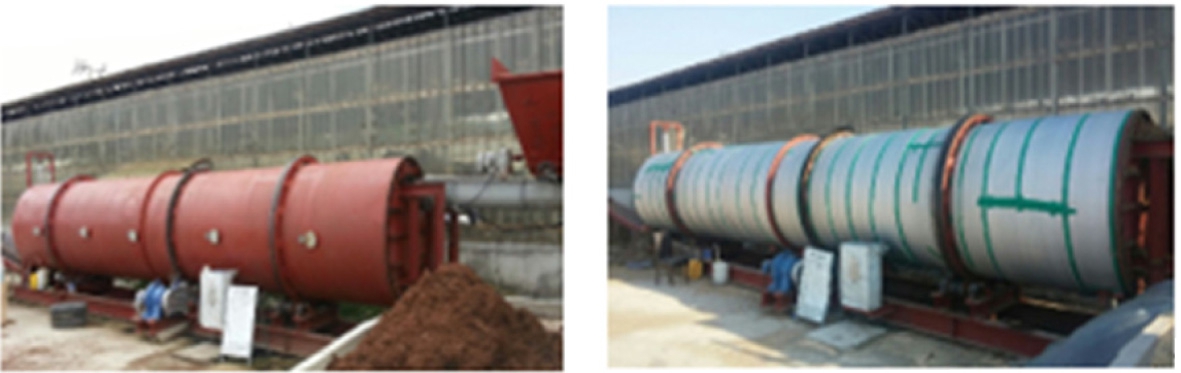
This compost was obtained from BK Environment construction Co., Ltd in Yong In, Korea and stored at 4°C for future assays of chemical characteristics and to mix with commercial soil. Compost B (CB) (swine manure and poultry manure and cattle manure and food scraps and sawdust and rice husk with 50%, 20%, 5%, 10%, 10%, and 5% respectively) was mature compost that was locally purchased from Jinju in Gyeongnam, Korea. The chemical characteristics of the commercial soil and the two type composts shown in Table 1.
Table 1.
Chemical characteristics of initial compost sample
| Treatment | ZCS | CA | CB | Limit values |
|---|---|---|---|---|
| Parameter | ||||
| pH | 5.70 | 5.41 | 6.25 | - |
| EC (dS m-1) | 0.54 | 3.99 | 7.25 | - |
| Moisture (%) | 59.12 | 65.24 | 48.76 | - |
| Total C (%) | 29.18 | 50.54 | 37.14 | - |
| Total N (%) | 0.72 | 2.34 | 2.57 | - |
| C:N | 40.48 | 21.58 | 14.44 | - |
| P2O5 (%) | 0.34 | 1.90 | 3.84 | - |
| K2O (%) | 1.64 | 1.24 | 1.85 | - |
| Cu (mg kg-1) | 7.50 | 142.63 | 175.65 | 200 |
| Zn (mg kg-1) | 24.70 | 561.00 | 347.70 | 500 |
| Pb (mg kg-1) | 0.20 | 0.55 | 1.05 | 75 |
| Cr (mg kg-1) | 120.82 | 8.71 | 25.75 | 150 |
| Ni (mg kg-1) | 31.10 | 9.68 | 7.58 | 100 |
| Cd (mg kg-1) | 0.01 | 0.17 | 0.56 | 5 |
| As (mg kg-1) | 3.75 | 1.47 | 8.20 | 25 |
Regulatory standards of Korea adapted from the Ministry of Agriculture and Forestry, Notification No. 1998-39 (NIAST, 2005).
2. Experimental design
The experiment had a completely randomized design and was performed in a greenhouse at Gyeongsang National University, Korea, from March 28 to April 27 for an overall 35 days of harvesting.
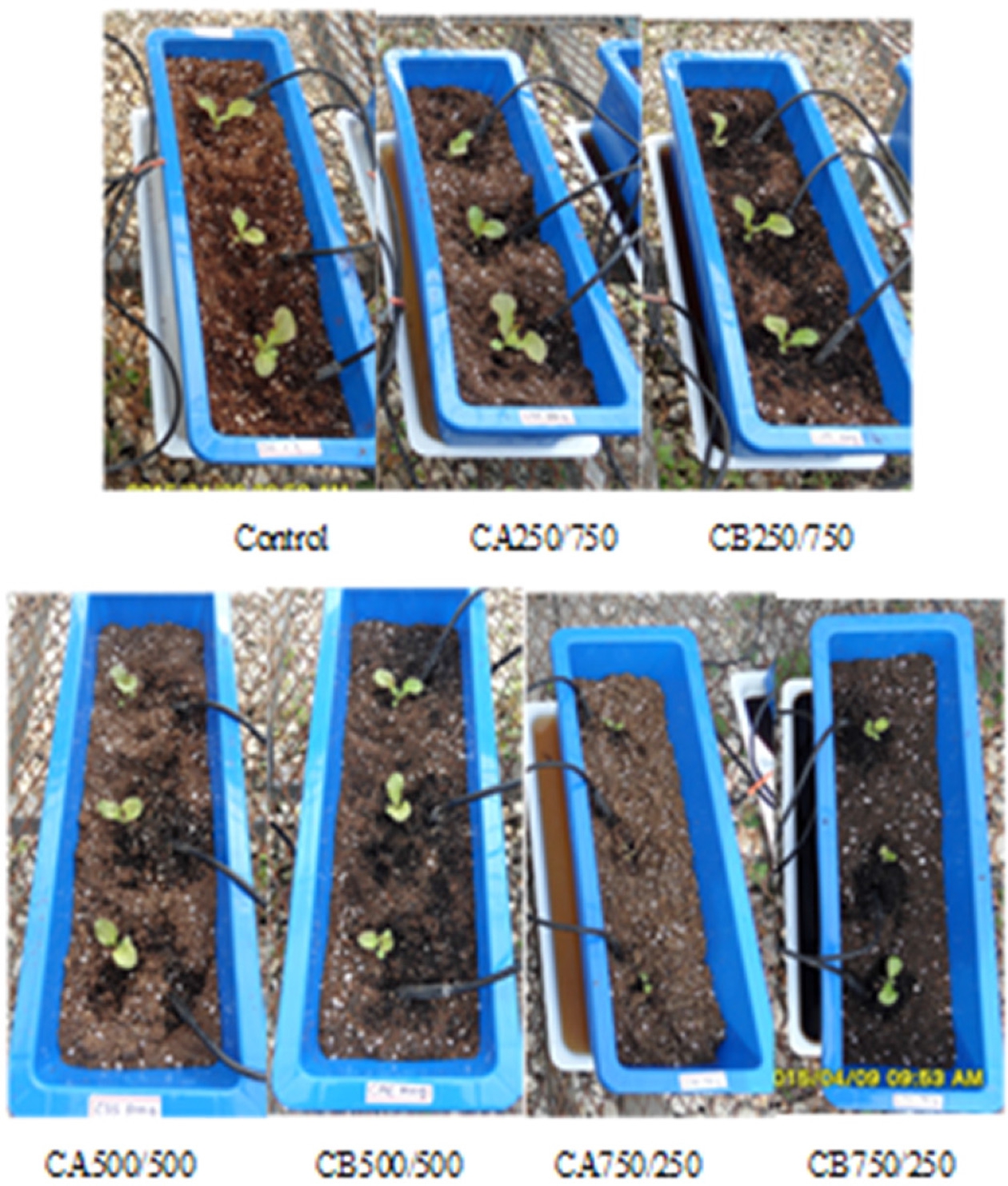
The two composts were dried at 105°C until stable weight and then immediately mixed with commercial soil; the suitable proportions of composts were mixed with commercial soil (dry weight) in square pots (1 L) at 250/750, 500/500, and 750/250 Fig. 2. All of the treatments included three replications. Three plants were cultivated in a pot and were provided by drip irrigation twice a day. At harvest, the chlorophyll content was measured using a chlorophyll meter (SPAD 502 plus, Konica Minolta Sensing, INC., JAPAN). After harvest, all of the lettuces were carefully dredged and meticulously washed with tap water to eliminate the attached soil particles; the fresh weights were immediately measured to protect from loss of leaf water. Leaf areas were measured using a portable leaf area meter (Model LI 3100, LICOR, USA) (Singh and Agrawel, 2010). Weights were determined after oven drying at 80°C overnight.
3. Chemical analysis
Soil samples and raw composts were dried oven at 105°C for 24h. The EC and pH values of the composts were measured using a pH meter (HM-31P) and EC meter (Cyberscan con110), respectively, in a suspension of distilled water with particular sediment at 1:5 after shaking for 1 h (w: v) (Singh and Agrawel, 2010). The total organic carbon and total nitrogen values were determined using high temperature furnace oxidation and subsequent direct measurement of total carbon and total nitrogen with an infrared detector (Leco-TruMac® Series, Saiant Joseph, US) (Lucas et al., 2014).
The P concentration was determined using a spectrophotometer and molybdovanadate phosphoric acid (Kitson and Mellon, 1944) and by flame atomic absorption spectrometry (50 Conc UV-Visible spectrometer). To determine the K and heavy metal contents, the sample was liquefied by HClO4:H2SO4 acid (9:1 ratio v/v); 0.2g was digested in 20mL of this acid for 1h at 100°C and 4h at 200°C on a hot plate after complete digestion. The solution was filtered with Whatman No. 42 papers. The contents of K, Zn, Cu, Cr, As, Cd, and Pb were determined from the resulting solution by inductively coupled plasma emission spectrometry (ICP-OES, Optimal Emission Spectrometer 4300 DV) (Lucas et al., 2014).
Results
1. Soil chemical properties
The pH values of the soil mixed with compost ranged from 5.39 to 6.22, which is in the weak acid range (Table 2). The 50% and 75% CA compost applications had weakly acidic characteristics, at pH 5.39 and 5.50 respectively. The EC values in the soil contained with CB were higher than those in the soil of all of the CA compost rates, but as the latter were lower, at 2.51, 2.80, and 3.20dSm-1 for 25%, 50%, and 75%, respectively. The EC values in the soil of all of the CB compost rates were higher than those of control, at 0.54d Sm-1, while the high EC value occurred in the 75%, 50%, and 25% treatment at 5.79, 4.65, and 3.35d Sm-1, respectively. The total carbon content in the soil depended on the compost rates; application at 75% of CA compost produced the highest of total carbon content of 43.5%. All of the compost rates significantly increased the highest value of the total nitrogen (T-N) and phosphorus (P) concentrations more than those of control, but the potassium (K) concentration in control was higher than those in all of the CA compost applications. However, the highest K concentration was given by CB compost at 75% (13.62g kg-1).
Table 2.
Changes of the chemical characteristics in the soil amended with different compost rates (mean ± standard deviation (n=3))
Values followed by the same letter do not differ significantly according to Duncan’s multiple range test (P<0.05).
Limit values according to (Abad et al., 1993): from Jayasinghe et al. (2010)
2. Heavy metal accumulation in soil
The heavy metal level depends on the concentration of compost rates that is added to the soil (Table 2). The concentrations of Cu (128mg kg-1), Zn (260mg kg-1), Pb (0.32mg kg-1) and, Cd (0.48mg kg-1) of high mature compost rate increased significantly compared to those of control, and the high As concentration increased significantly at 75% mature compost (6.69mg kg-1) and at 25% immature compost (6.48mg kg-1). Surprisingly, the highest values of Cr and Ni were given by control (120.82 and 31.10mg kg-1).
3. Effect on nutrient change during growth
The total carbon of both the composts showed different variances that they tend to increase relative with the mature compost use for as 75% and 25%, respectively, while the immature was reduced in all ratios (Fig. 3a). The nitrogen found that it was increased during 10 days and was declined during 25 for immature compost (Fig. 3b). As for the mature compost the amount of nitrogen increased at 25 days and was declined at 35 days except its applying at 50% that it could be induced increasingly (Fig. 3d). All ratios of immature and mature compost showed the number of phosphorus not only more than control but it also continuously increased after applying into soil (Fig. 3e, 3f).
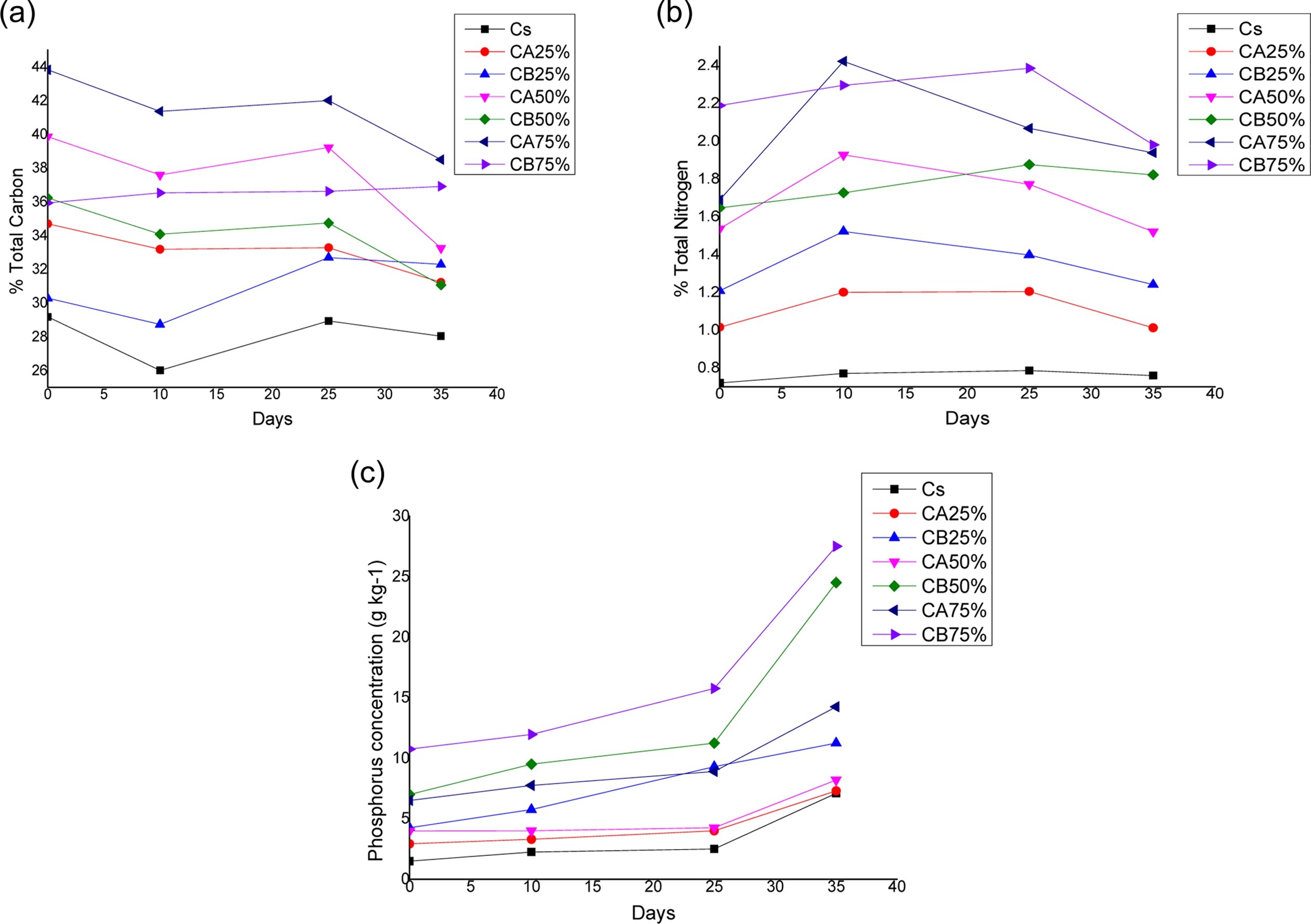
Fig. 3.
Change of organic and inorganic values on different rates of composts. (a) change of total carbon of immature compost (CA) and mature compost (CB), (b) change of total nitrogen of immature compost (CA) and mature compost (CB), (c) change of phosphorus concentration on immature compost (CA) and mature compost (CB).
4. Effect on development of plant
Composts are used as fertilizer sources to increase the essential nutrient for plant growth, however, they can induce the salt toxicity and inhibit plant growth. Thus, Table 3 presented that using high ratio of these composts significantly decreased of above-ground biomass, fresh weight, dry weight, and leaf area including changes of root to shoot ratio, which is an indicator of plant health. While use for low ratio at 25% was the reasonable ratio to contribute the plant growth, especially the mature compost showed that higher fresh weight and dry weight gained as 51.0 and 3.68g, especially the mature compost showed that fresh and dry weight gained high as 51 and 3.68g. In contrast, the immature compost gained rather low as 31.7 and 2.29g respectively and it was lower than control (57.9 and 3.55g) in the same with the leaf area which was gained in Table 3. The chlorophyll content was increased by using compost while as the mature compost induced on increasing the chlorophyll approximately 23.5 which did not show statistical different significance use for immature compost (23.4)
Table 3.
Effect of the soil amended with different compost rates on lettuce growth
| Treatment | Compost rates (%) | Fresh wt (g.) | Dry wt (g) | R/S ratio | Chl (SPAD unit) | Leaves area (cm2) |
|---|---|---|---|---|---|---|
| CS | 0 | 57.9a | 3.55a | 0.33a | 19.9b | 65.3a |
| CA 25% | 25 | 31.7c | 2.29b | 0.31a | 23.4a | 39.6b |
| CA 50% | 50 | 4.5e | 0.29d | 0.16b | 20.9ab | 10.8c |
| CA 75% | 75 | nd | nd | nd | nd | nd |
| CB 25% | 25 | 51.0b | 3.68a | 0.35a | 23.5a | 63.2a |
| CB 50% | 50 | 21.8d | 1.55c | 0.34a | 21.6ab | 40.5b |
| CB 75% | 75 | nd | nd | nd | nd | nd |
| ANOVA | * | * | * | * | * | |
Discussion
The pH value for plant growth including lettuce is generally range approximately 6-8; the lower pH (5.5 to 3.5) inhibits the primary root (Inoue, et al., 2000). The pH values of the soil after mixing with compost ranged from 5.39 to 6.22, in the weak acid range and less than the appropriate range for plant growth. In particular, the applications of 50% and 75% CA compost were 5.39 and 5.50, respectively which expected as acidic characteristics (Table 2). CA was immature compost regarding the amount of ammonia, which leaves out during of fermentation for 15 days; the oxidation of ammonium completely converted ammonium to nitrate at 21 days that bacteria responsible for nitrification are strongly inhibited by temperature greater than 40°C (Ko et al., 2008). CA could inhibit root development due to a number of remained ammonium because of insufficient fermentation time and it showed high C/N ratio. In contrast, all of the mixing rates of CB and the rate of 25% of CA increased the pH value of the soil. Similarly, Ouedraogo et al. (2001) and Courtney and Mullen (2008) found that increasing of pH depended on its concentration ratio. It is important to avoid high salt content in compost, which have a phototoxic on plant growth. For lettuce growth, EC should be not over 2dS m-1. This parameter can also be used to indicate extent of the mineralization of the matrix that is beginning composted (Alvarenga et al., 2015). Our studies found that EC in the soil after mixing with all of the rates of CB was higher those after mixing with all of the rates of CA and CS because CB contained higher nutrient contents than CA and CS (Table 2). Singh and Agrawal (2010) reported that an increased EC level might be found with increased application rates of these composts in soil. Thus, the highest EC values of CA and CB composts were found with the 75% application rate, followed by the 50% and 25% application rates. These results explain the higher EC value in high application rate. Consequently, the use of the lowest rates of compost should be limited to prevent harmful effects on crops. The total carbon content in the soil depended on the organic matter content (Singh and Agrawal, 2010; Alvarenga et al., 2015). All of the compost rates increased the total C compared to control. The 75% application rate of CA compost produced the highest total carbon content, at 43.5% (Table 2).
We assumed that incomplete decomposition would leave humic organic compounds in composting process. The results demonstrate the increase in plant-available of the total nitrogen and phosphorus. The total nitrogen and phosphorus, in particular, all of the compost rates significantly increased the total nitrogen (T-N) and phosphorus (P) concentrations more than control, but the potassium (K) concentration in control was higher than that in the other application rates of the CA compost.
The actual composition of control is unknown; thus, the high K accumulation can be not explained. Composts, however, can also increase the heavy metal levels in soil. Usually, the heavy metal concentration depends on the compost concentration that is added to the soil (Courtney and Mullen, 2008; Castro et al., 2009). Many heavy metals in animal manure such as As, Cu, Cr, and Zn have considerably high contents because they are found in the feed and are widely supplemented in industrial animal farming (Wang et al., 2013). But Cd and Pb are not statistically correlated between feed and manure. In this case, Cu, Zn, Pb, Cd, and As were present in both composts, and their levels increased with the application rate compared to control, as shown in Table 2. The highest Cr and Ni contents were found in control. It assumed that used commercial soil as control followed by a contamination of agricultural waste residues within commercial soil component. (Alvarenga et al., 2015), along with high Cr and Ni concentrations, as shown in Table 1.
Furthermore, Singh and Agrawal (2010) suggested that the phyto-available fraction of heavy metals is a good indicator of the bioavailability and can be a tool for risk assessment. Total heavy metals, however, also include the fractions that are not readily available to the plants. In addition to decreased pH and high EC values in the soil after mixing with compost led to an increased availability of heavy metals. Similarly, the levels of heavy metals increased following the addition of different rates relative with high EC values of the composts, while the mature compost (CB) in Table 2 had a potentially higher risk of heavy metal accumulation than the immature compost (CA). However, these values are below the stated limits for the assessment of their combination with a growth medium (Abad et al., 2001).
The both of composts are used as fertilizer sources to increase the necessary nutrients in soil but can also induce soil salinity, which may be toxic and inhibit plant growth. The nutrient concentrations increased, leading to higher levels of organic carbon, total N, available P, and exchangeable K+. These reasons are the supplementation of toxic salinity and to decreased pH values in the soil (Garcia-Gomez et al., 2002; Courtney and Mullen, 2008; Singh and Agrawal, 2010; Martinez-Fernandez et al. 2014). Thus, these results support application at all rates of these composts during lettuce cultivation. The use of these composts significantly decreased the aboveground biomass, fresh weight, dry weight, and leaf area of lettuce and induced changes in root-to-shoot ratio but increased the chlorophyll content by high N concentration of the raw composts in Table 1. These results can be seen in Table 3.
These results agree with previously described report (Garcia-Gomez et al., 2002), in which a higher proportion of compost produced higher EC values and lower yields, especially in calceolaria, which is a salt-sensitive species. It is possible that the cations and anions contributing to EC in compost substrates are mainly nutrients, such as K+, Cl-, and No3-N, having an osmotic effect on plant growth. Thus, high lettuce productivity of edible biomass was found under conditions of low EC at the 25% application rate when compost was mixed. Additionally, the high nutrient capability of CB enhances lettuce growth more than the CA at every application rate. Even the immature compost had sufficient nutrition and fewer heavy metals, but its NH3+ content caused consequent problems with root development; thus, immature compost should be used at the lowest level to reduce risk in plant growth.
Conclusion
The application of composts and the use of different rates improved the soil qualities, especially with the mature compost (CB compost), which had higher levels of available nutrients than immature compost (CA compost), but CB compost significantly induced the accumulation of heavy metal in soil, which may be risk regarding bioavailability and mobility into plant cells by photosynthetic activity for development following plant requirements. pH and EC values were improved by composts and were contributed to reasonable utilization. When immature compost was used, it caused an imbalance of some nutrients and toxic nutrient forms in the soil. But immature compost was potentially amended when used at 25%. We remind that this rate may not be appropriate for lettuce cultivation. This may be available if the rate is lower than used rate in this trial. Determination of reasonable rate of mature compost not only increased the contents of many nutrients but also had low heavy metal accumulation and slightly increased the dry weight of lettuce.