Protected Horticulture and Plant Factory. 30 April 2016. 89-94
https://doi.org/10.12791/KSBEC.2016.25.2.89

ABSTRACT


MAIN

서 론

식물 생산 시스템에서 배양액은 작물의 생육과 수량에 영향을 주는 가장 중요한 요인 중 하나이다(Choi 등,2005). 배양액 개발을 위한 방법으로는 정상적인 생육을 한 식물을 무기 분석하여 양이온과 음이온 비율로 배양 액을 조성하는 방법(Choi 등, 2005; Dufour와 Guérin, 2005)과 양수분흡수율을 이용한 방법(Yamasaki, 1981, 1982) 등이 있다. 무기 성분 비율에 따른 배양액 조성 방법이나 양수분흡수율 방법은 식물체, 배지 및 환경요 인 등에 따라 흡수율이 달라질 수 있다(Dufour와 Guérin, 2005; Yamasaki, 1981).

재식밀도는 작물의 생육과 수량에 영향을 주는 중요한 요인이다(Kahn 등, 1997; Leskovar 등, 2000; Maynard 와 Scott, 1998; Reiners와 Riggs, 1999; Schultheis 등,1999). 단위면적당 수량은 재식밀도가 높을수록 증가하 지만, 식물체당 상품 수량은 감소하는 경향을 보인다 (Kulter 등, 2001; Locascio와 Stall, 1994; Motsenbocker, 1996). 또한 재식밀도는 식물 생산 시스템 설계를 위해 작물의 생육과 생산성을 예측하기 위한 요인 중 하나이 며, 적정재식밀도는 생육을 극대화 할 수 있는 방법으로 도 이용될 수 있다.

식물공장과 같은 식물 생산 시스템은 지상부와 지하부 환경을 최적상태로 제어하여 식물을 연속적으로 생산할 수 있는 시스템이다. 특히, 식물공장 시스템내의 광도를 높일 경우, 작물 생산량도 증가하는데, 싹채소류는 7- 15μmol·m-2·s-1, 엽채류는 200-300μmol·m-2·s-1, 과채류는 500μmol·m-2·s-1 이 적합한 수준으로 알려져 있다(Yoon과Choi, 2011). 광도는 경제성과 밀접한 관련이 있어 식물 체에 적당한 광도를 제시할 필요가 있다. 인공광이용형 식물공장에서 고부가가치와 기능성 작물로 알려진 common ice plant에 대한 연구들이 많이 시도되고 있다 (Cha 등, 2014). 그러나common ice plant에 대한 식물공 장 시스템에서의 재배 기술과 생육 정보들은 많이 알려 져 있지 않다.

따라서, 본 연구는 인공광 이용형 common ice plant 식 물공장에서 생육에 대한 적합한 배양액 조성, 배양액 산도, 급액 간격, 광도 및 재식거리를 알아보고자 수행하였다.

재료 및 방법

공시작물은 자가 채종한 common ice plant를 사용하였 다. 시험은 2011년 6월부터 2012년 7월까지 수행하였다. 우레탄 스폰지(2.5×2.5×2.5cm)에 파종하였으며, 본엽이 2매 나온 시기에 베드에 정식하였다. 수경재배시스템은 3층으 로 구성된 박막수경(NFT)시스템(240×60×200cm, L×W×H) 으로, 배양액통 용량은 110L였으며, 배양액량은 90L 로 하였다. 배양액 공급은 10분 간격으로 ON/OFF 제어하 였으며, 배양액의 pH와 EC는 1-2일 간격으로 측정하여 보정하였다.

광도, 온도, 상대습도 및 이산화탄소 농도는 광 센서 (LI-190, Li-cor, Lincoln, Nebraska, USA), 온도와 상대 습도 센서(HMP45AC, Campbell Scientific, Logan UT, USA)와 이산화탄소 센서(GMP222, Vaisala, Helsinki, Finland)를 이용하여 각각 측정하였다. 식물공장내 온도, 상대습도와 이산화탄소 농도는 제어기(SDM-CD16AC, Campbell Scientific, Logan UT, USA)를 이용하여 ON/ OFF 제어하였다. 온도는 냉방기(HP-N239L, Samsung Electronics Co., Ltd., Korea)과 난방기(HV-7800, Hanvit System Co., Ltd., Korea)를 이용하여 20~25°C로 관리하였 으며, 상대습도는 가습기(NH-5, Hwajeun Eng., Korea)와 제습기(SG-M220S-4, Shinan Green-Tech Co., Ltd., Korea) 를 이용하여 60~70%로 관리하였다. 이산화탄소 농도는 지하공기를 이용하여(Kim 등, 2007) 600~900μmol·mol-1 로 관리하였다. 공기 유동은 공기순환팬(SGA-120, Shinan Green-Tech Co., Ltd., Korea)을 이용하였다. 센서위치는 바닥면으로부터 1.5m에 3곳에 설치하여 실측한 평균값을 이용하여 설정값에 맞게 제어하였다. 모든 환경자료는 데 이터수집장치(CR-1000, Campbell Scientific, Logan UT, USA)를 이용하여 1시간마다 매일 수집하였다.

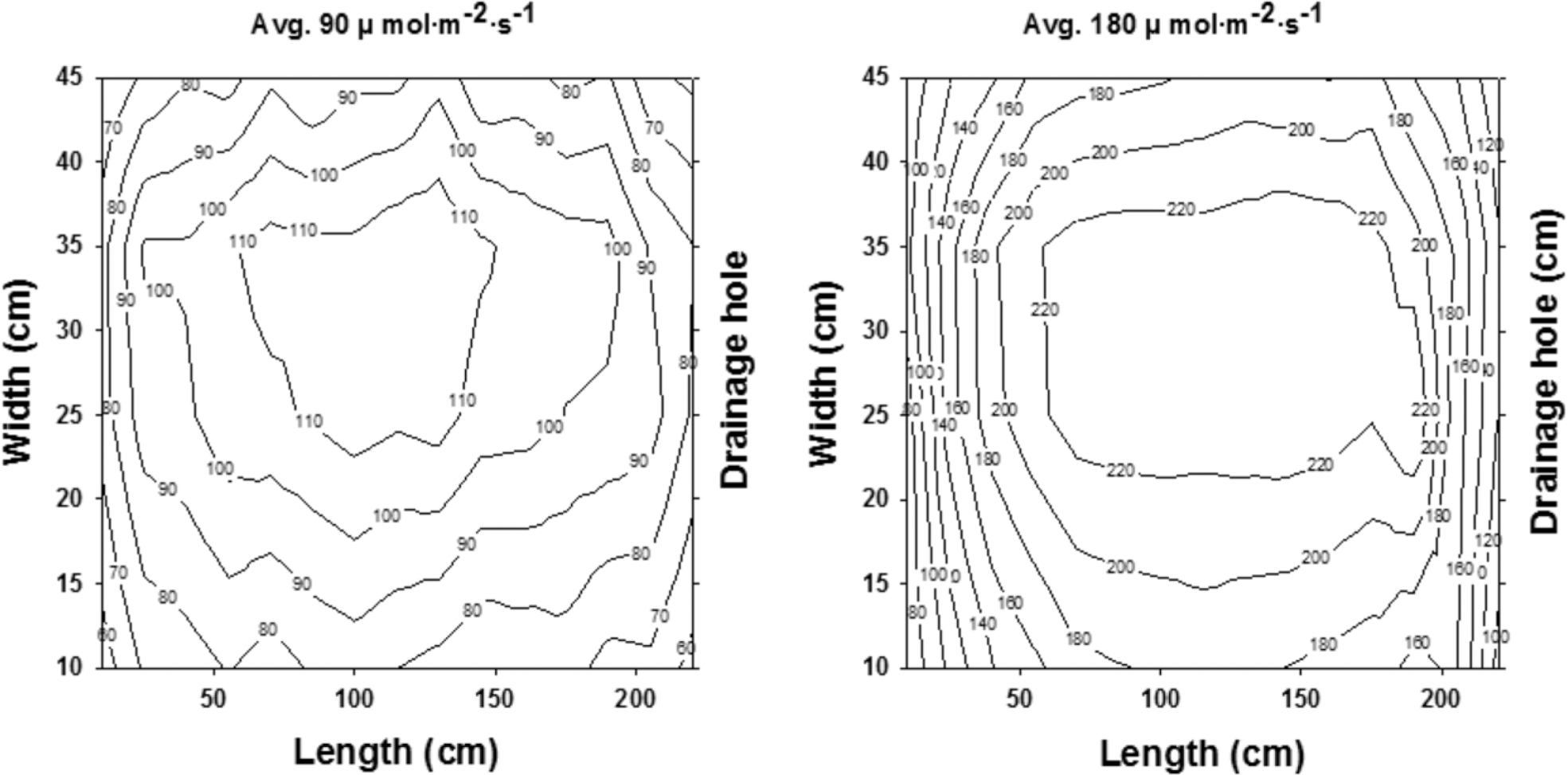
배양액은 식물체를 분석하여 양이온 비율에 따라 조성하 였으며(Table 1), 개발 배양액(Nutrient solution of Jeju National University, NJNU)과 일본원예시험장 배양액 (Nutrient solution of Horticultural Experiment Station in Japan, NHES)을 생육 비교하였다. 배양액의 pH는 6.0(±0.4) 과 7.0(±0.3)에서 생육 비교하였으며, 배양액 공급도 5분 (ON/OFF)과 10분(ON/OFF)마다 공급하여 생육 비교하 였다. 광도는 평균 90μmol·m-2·s-1(55-119μmol·m-2·s-1)과 평 균 180μmol·m-2·s-1(64-241μmol·m-2·s-1) 관리하였으며 (Fig. 1), 일장조절에서 12시간 명기와 12시간 암기로 설 정하였다. 재식거리는 열간 간격을 15cm로 고정한 후 열내 간격을 10, 15, 20과 25cm로 하여 정식 후 28일에 생육 비교하였다.

Table 1.

The composition of NHES and NJNU nutrient solution for common ice plant in hydroponic system.

Nutrient solutionzNutrient solution (mM • L-1)
NO3-NNH4-NPKCaMg

NHES16.01.331.338.04.02.0
NJNU7.00.650.654.01.61.0
z NHES : The nutrient solution of Horticultural Experiment Station in Japan.
NJNU : The nutrient solution of Jeju National University.
https://cdn.apub.kr/journalsite/sites/phpf/2016-025-02/KSBEC-25-2-89/images/KSBEC-25-2-89_F1.jpg
Fig. 1.

Distribution of light intensity under 3-band radiation type fluorescent lamps.

EC는 1.0dS·m-1으로 설정하였으며, 배양액의 pH와 EC 는 1-2일 간격으로 측정하여 수돗물과 농축 양액으로 보 정하였다. 측정은 생체중을 측정한 다음, 70°C에서 72시 간 건조한 후 건물중을 측정하였다. 실험구 배치는 완전 임의배치법으로 3반복하였으며, SAS(Statistical Analysis System, Ver 9.3, Cary, NC, USA) 프로그램을 이용하여 Duncan 다중 검정하였다.

결과 및 고찰

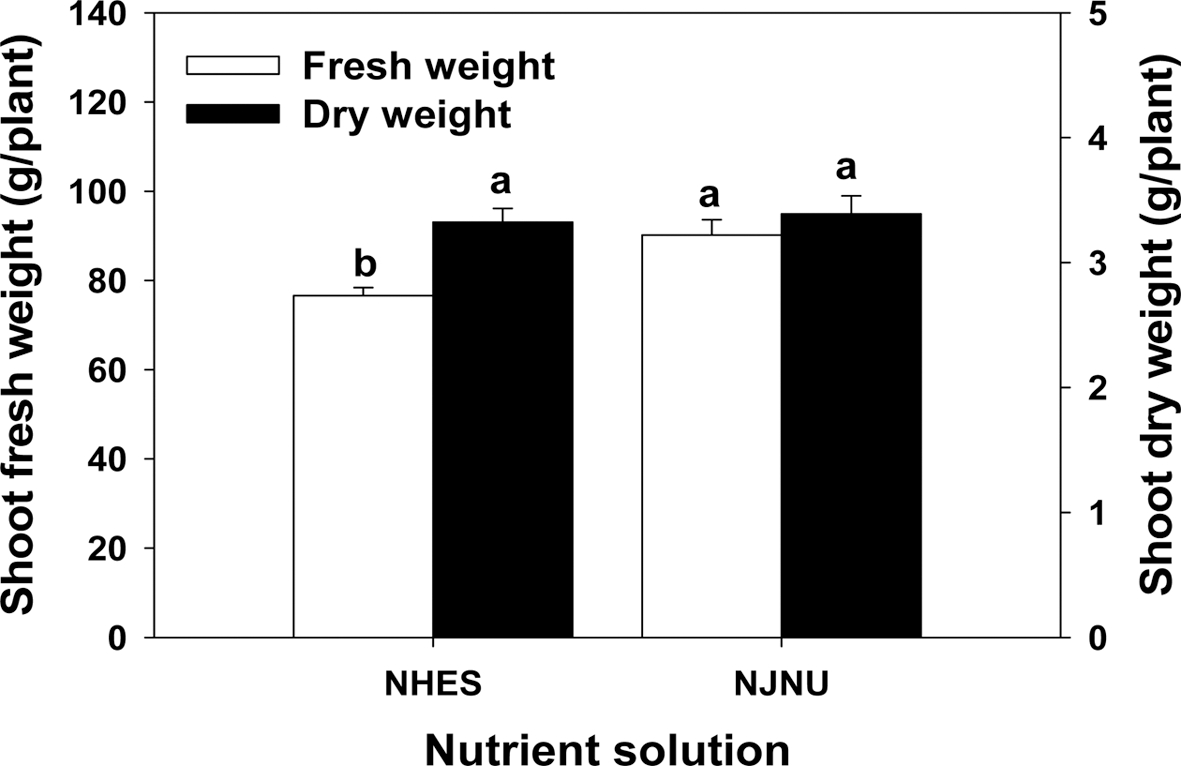
일본원예시험장액(NHES)과 개발 배양액(NJNU)간의 생육 비교는 Fig. 2와 같다. 지상부 생체중은 유의적인 차이를 보인 반면에, 지상부 건물중은 유의적인 차이를 보이지 않았으나, 지상부 생체중은 개발 배양액에서 좋 았다. 따라서, 새롭게 개발 배양액은 common ice plant 생육에 적합한 배양액이라 결론을 내렸으며, 이후 재배 는 개발 배양액으로 처리하였다.
https://cdn.apub.kr/journalsite/sites/phpf/2016-025-02/KSBEC-25-2-89/images/KSBEC-25-2-89_F2.jpg
Fig. 2.

Shoot fresh and dry weights per plant of common ice plant 35 days after transplanting under different nutrient solution. Different letters indicate statistical different at the p ≥ 0.05 by Duncan’s multiple range test (n=5).

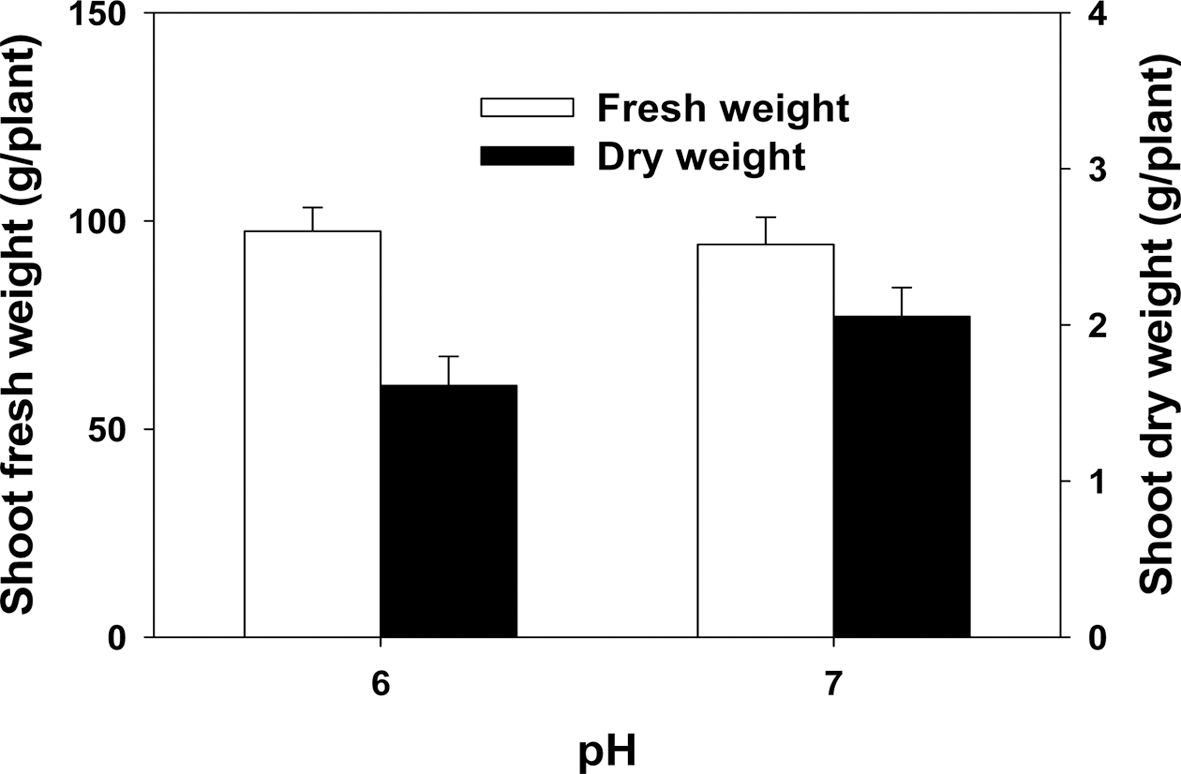
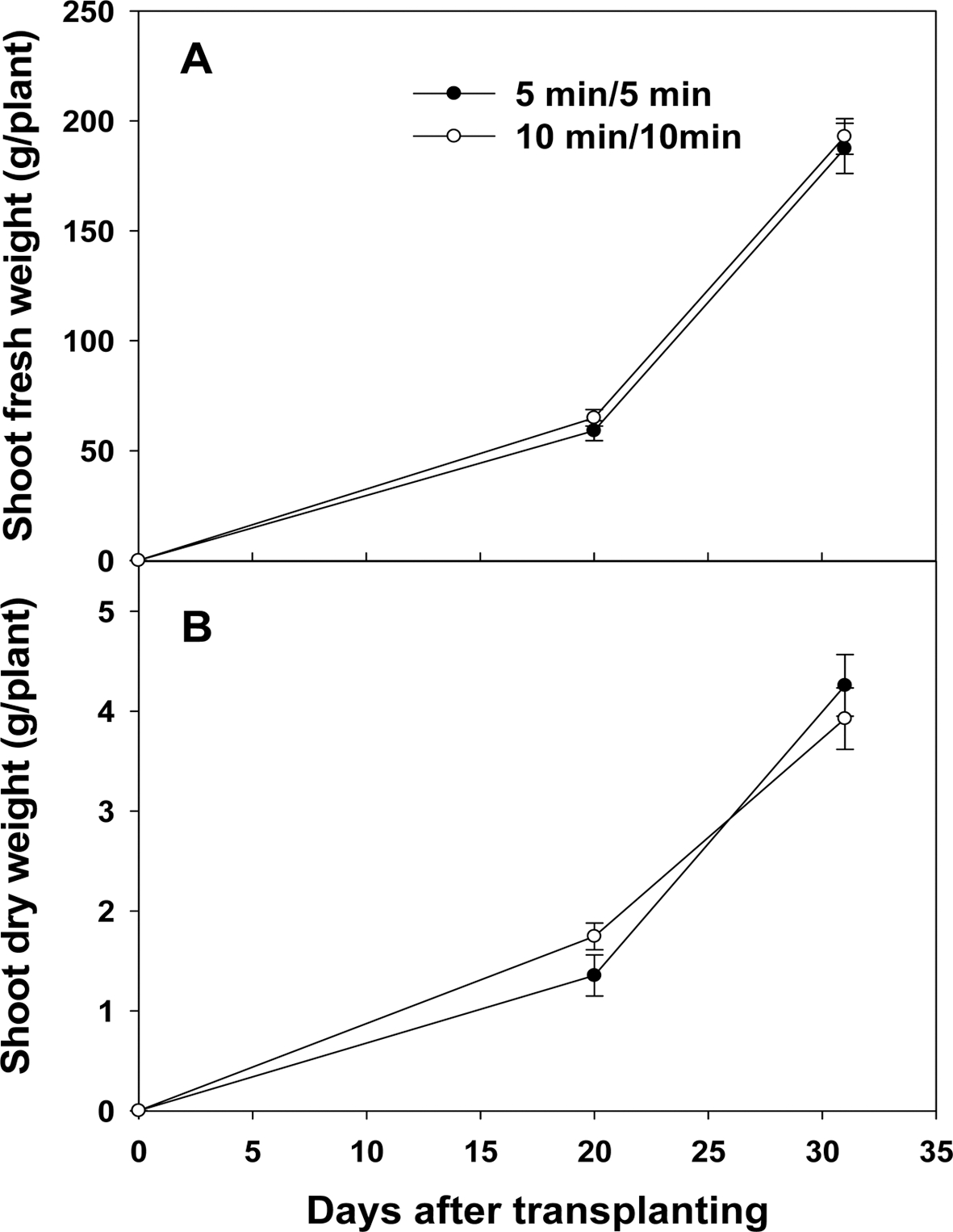
새롭게 개발 배양액의 pH와 배양액 공급 간격에 따른 생육 결과는 각각 Fig. 3과 Fig. 4와 같다. 배양액 pH간 과 배양액 공급 간격간 지상부 생체중과 건물중은 유의 적인 차이를 보이지 않았다.
https://cdn.apub.kr/journalsite/sites/phpf/2016-025-02/KSBEC-25-2-89/images/KSBEC-25-2-89_F3.jpg
Fig. 3.

Shoot fresh and dry weights per plant of common ice plant 24 days after transplanting under different pH of nutrient solution. Vertical bars represent the standard error (n=15).

https://cdn.apub.kr/journalsite/sites/phpf/2016-025-02/KSBEC-25-2-89/images/KSBEC-25-2-89_F4.jpg
Fig. 4.

Shoot fresh and dry weights per plant of common ice plant under 32 days after transplanting different irrigation interval of nutrient solution. Vertical bars represent the standard error (n=10).

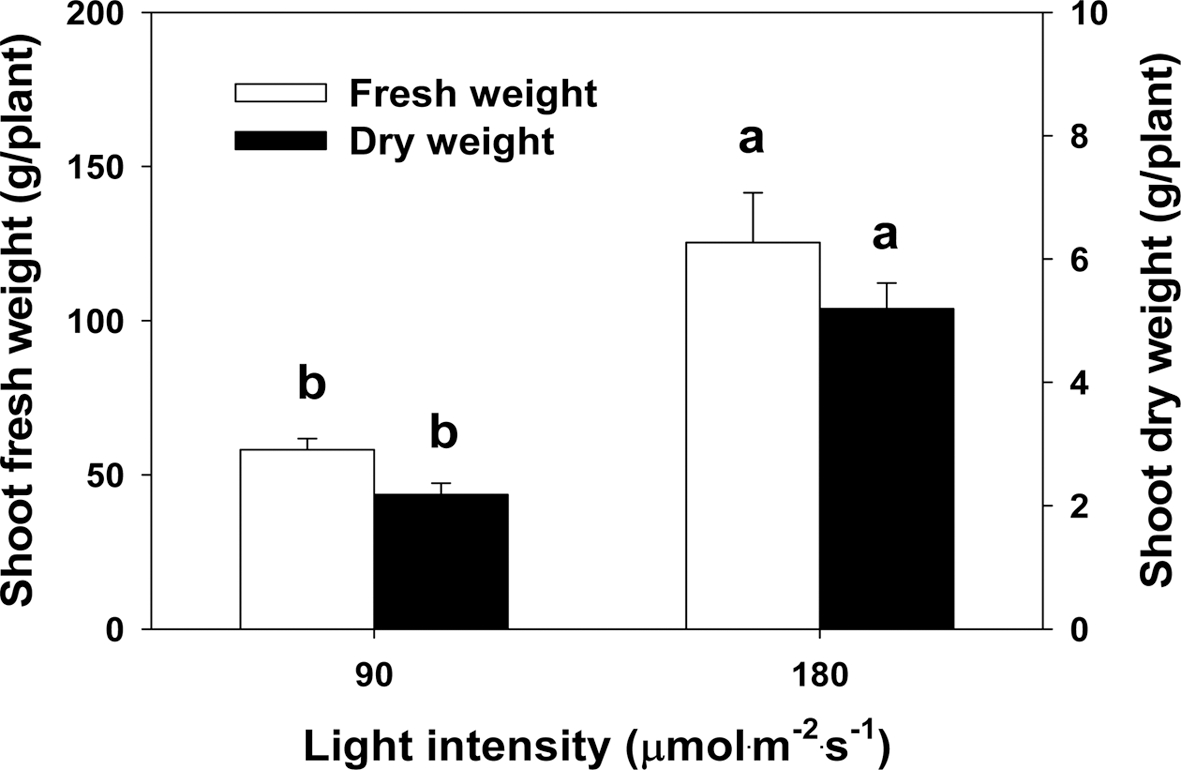
광도에 따른 지상부 생체중과 건물중 차이는 Fig. 5와 같다. 지상부 생체중과 건물중 모두 유의적인 차이를 보 였다. 광도 180μmol·m-2·s-1 처리구에서 지상부 생체중과 건물중이 높았다. Cha 등(2014)은 common ice plant 재 배를 위한 적정 광도는 150-200μmol·m-2·s-1 수준이라고 하였다. 본 연구에서도 광도가 낮은 90μmol·m-2·s-1에서 낮은 생육량을 보인 것은 적정 광도 수준 이하였기 때 문으로 생각된다.
https://cdn.apub.kr/journalsite/sites/phpf/2016-025-02/KSBEC-25-2-89/images/KSBEC-25-2-89_F5.jpg
Fig. 5.

Shoot fresh and dry weights per plant of common ice plant under 30 days after transplanting different light intensity. Different letters indicate statistical different at the p ≥ 0.05 by Duncan’s multiple range test (n=10).

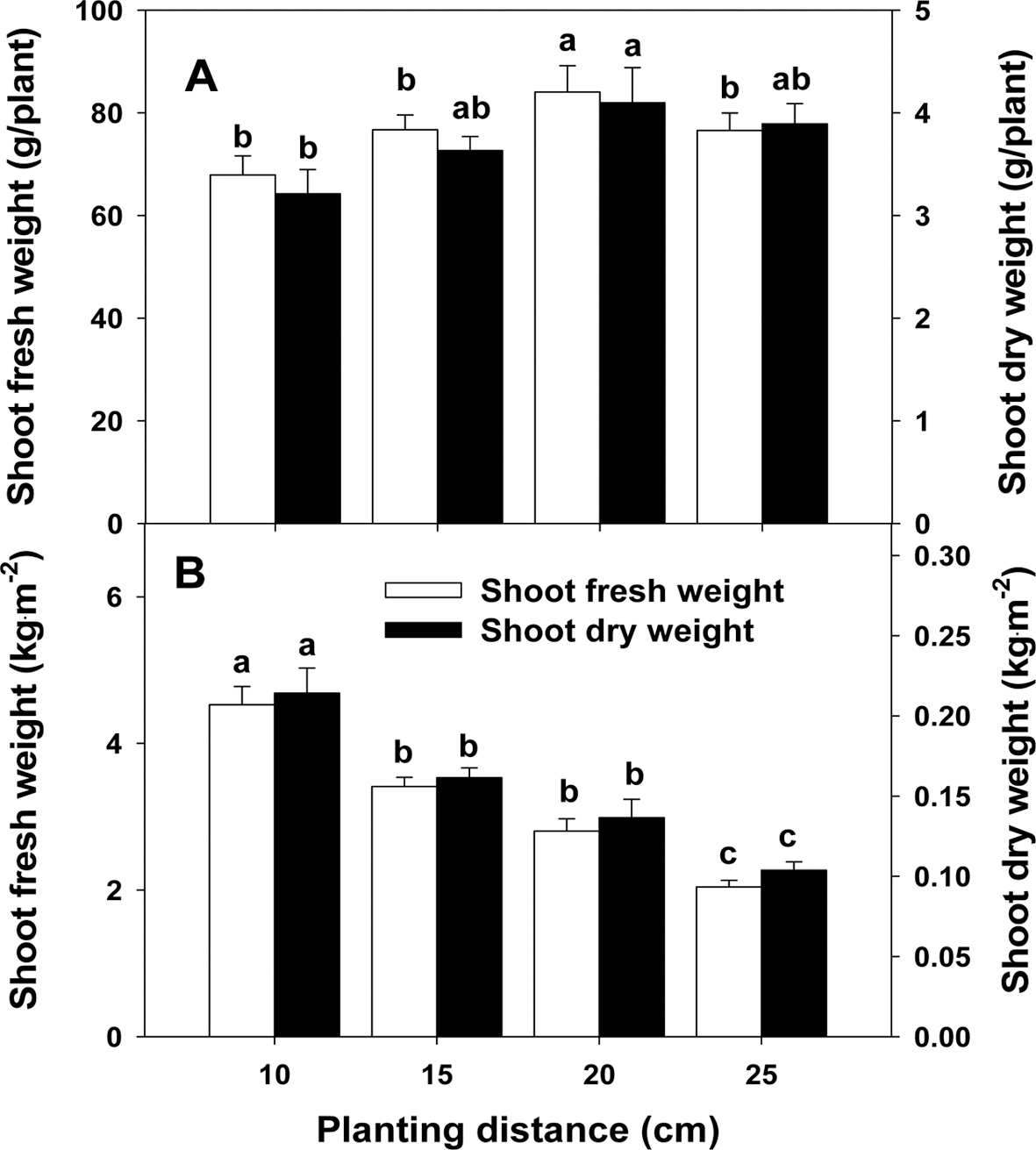
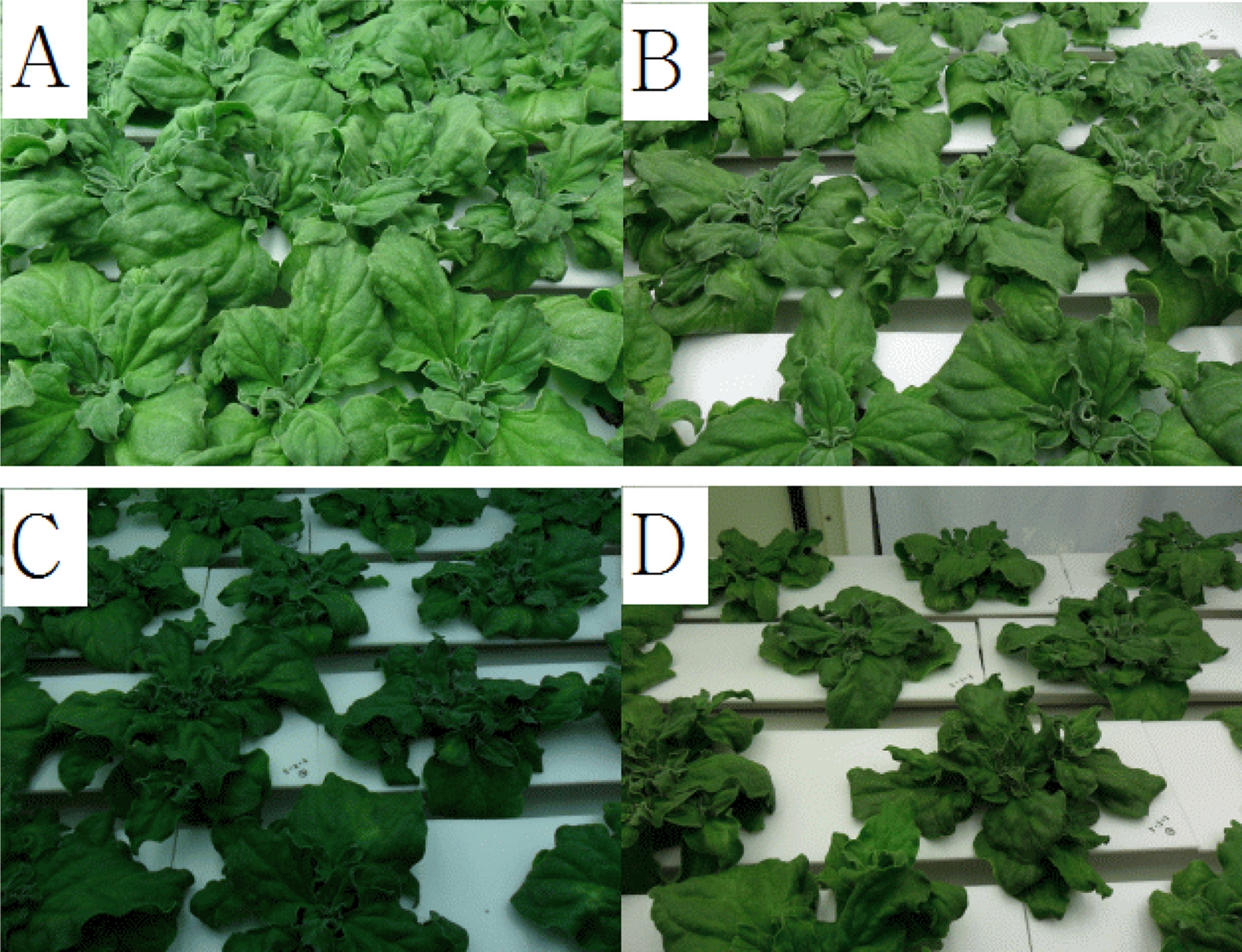
재식거리에 따른 생육과 수량 및 생육 상태는 각각 Fig. 6과 Fig. 7과 같다. 개체당 생육량은 재식거리 20cm가 가장 높은 생육을 보인 반면에(Fig. 6A), 단위면 적당 수량은 재식거리 10cm가 가장 많았다(Fig. 6B). NeSmith(1993)Reiners와 Riggs(1999)는 재식밀도가 높을수록 한계점에 도달할 때까지 단위면적당 수량은 계 속해서 증가한다라고 하였다. 본 연구에서는 단위면적당 수량이 한계점에 도달하지 않았다. Fig. 7에서 보는 것처 럼 재식거리가 짧을수록 잎이 겹쳐졌으며, 재식거리가 짧 은 15×10cm 처리구에서 잎이 포개짐과 측지 발생에 따라 상품이 나빠지는 경향을 보였다. Carvalho와 Heuvelink(2001)는 재식밀도는 크기, 줄기 길이, 측지수와 같은 형 태적인 측면에 영향을 준다라고 하였는데, 본 연구에서 도 크기와 측지수 발생에 영향을 주었다. 결론적으로 개 체당 생육과 단위면적당 수량을 고려해 볼 때, common ice plant의 적정 재식거리는 15×15cm였다.
https://cdn.apub.kr/journalsite/sites/phpf/2016-025-02/KSBEC-25-2-89/images/KSBEC-25-2-89_F6.jpg
Fig. 6.

Shoot fresh and dry weights per plant (A) and shoot fresh and dry weights per area (B) of common ice plant 28 days after transplanting under different planting distance. Between-row distance is 15 cm. Different letters indicate statistical different at the p ≥ 0.05 by Duncan’s multiple range test (n=9).
https://cdn.apub.kr/journalsite/sites/phpf/2016-025-02/KSBEC-25-2-89/images/KSBEC-25-2-89_F7.jpg
Fig. 7.

Growth condition of common ice plant under different planting distances (A: 15×10cm, B: 15×15cm, C: 15×20cm and D: 15×25cm). Photographs were taken at 26 days after transplanting.

식물 생산 시스템에서 common ice plant 생육에 적합 한 배양액 관리(조성, pH와 급액간격)와 재배관리(광도와 재식밀도)를 알아본 결과, 생육에 적합한 배양액 조성으 로 pH 6.0-7.0로, 급액 10분 간격으로 공급해 주는 것이 좋으며, 광도 180μmol·m-2·s-1와 재식밀도 15×15cm로 재 배하는 것이 좋을 것으로 판단된다.


사 사

본 논문은 2010년 한국연구재단 신진연구지원사업 (연 구장비지원) (과제번호 : 1345115074)의 지원에 의해 이 루어진 것임.

References

1
Carvalho, S.M.P. and E. Heuvelink. 2001. Influence of greenhouse climate and plant density o external quality ofchrysamthemum (Dendrantherma gradiflorum (Ramat.) Kitamura): First steps towards a quality model. J. Hort. Sci. Biotechnol. 76:249-258.
10.1080/14620316.2001.11511359
2
Cha, M.K., J.S. Kim, J.H. Shin, J.E. Son, and Y.Y. Cho. 2014. Practical design of an artificial light-used plant factory for common ice plant (Mesembryanthemum crystallinum L.). Protected Hort. Plant Fac. 23:371-375 (in Korean).
10.12791/KSBEC.2014.23.4.371
3
Choi, K.Y., E.Y. Yang, D.K. Park, Y.C. Kim, T.C. Seo, H.K. Yun, and H.D. Seo. 2005. Development of nutrient solution for hydroponics of Cruciferae leaf vegetables based on nutrient-water absorption rate and the cation ratio. J. BioEnv. Con. 14:289-297 (in Korean).
4
Dufour, L. and V. Guérin. 2005. Nutrient solution effects on the development and yield of Anthurium andreanum Lind. in tropical soilless conditions. Sc. Hort. 105:269-282.
10.1016/j.scienta.2005.01.022
5
Kahn, B.A., J.R. Cooksey, and J.E. Motes. 1997. Within-row spacing effects on traits of importance to mechanical harvest in paprika-type peppers. Sci. Hort. 69:31-39.
10.1016/S0304-4238(96)00981-8
6
Kim, J.H., M.S. Sung, I.S. So, and H.N. Hyun. 2007. Study on the distribution and utilization of basalt underground air in Jeju volcanic island. Kor. J. Hort. Sci. Technol. and J. BioEnv. Con. 10 (Suppl. II):113 (Abstr.) (in Korean).
7
Kultur, F., H.C. Harrison, and J.E. Staub. 2001. Spacing and genotype affect fruit sugar concentration, yield, and fruit size of muskmelon. HortScience 36:274-278.
10.21273/HORTSCI.36.2.274
8
Leskovar, D.I., L.A. Stein, and F.J. Dainello. 2000. Planting systems influence growth dynamics and quality of fresh market spinach. HortScience 35:1238-1240.
10.21273/HORTSCI.35.7.1238
9
Locascio, S.J. and W.M. Stall. 1994. Bell pepper yield as influenced by plant spacing and row arrangement. J. Amer. Soc. Hort. Sci. 119:899-902.
10.21273/JASHS.119.5.899
10
Maynard, E.T. and W.D. Scott. 1998. Plant spacing affects yield of 'Superstar' muskmelon. HortScience 33:52-54.
11
Motsenbocker, C.E. 1996. In-row plant spacing affects growth and yield of pepperoncini pepper. HortScience 31:198-200.
10.21273/HORTSCI.31.2.198
12
NeSmith, D.S. 1993. Plant spacing influences watermelon yield and yield components. HortScience 28:885-887.
10.21273/HORTSCI.28.9.885
13
Reiners, S. and D.I.M. Riggs. 1999. Plant population affects yield and fruit size of pumpkin. HortScience 34:1076-1078.
10.21273/HORTSCI.34.6.1076
14
Schultheis, J.R., S.A. Walters, D.E. Adams, and E.A. Esters. 1999. In-row plant spacing and date of harvest of 'Beauregard' sweet potato affect yield and return on investment. HortScience 34:1229-1233.
10.21273/HORTSCI.34.7.1229
15
Yamasaki, K. 1981. The problem and present state of hydroponic culture (1). Nutrient solution management of hydroponic culture-nutritive characteristic of each crop by nutrient/water. Agr. and Hort. 56:563-568.
16
Yamasaki, K. 1982. A review on solution culture. Hakuyusha, Toyko. p.34-49.
17
Yoon, C.G. and H.K. Choi. 2011. A study on the various light source radiation conditions and use of LED illumination for plant factory. Journal of KIIEE 25(10):14-22 (in Korean).
10.5207/JIEIE.2011.25.10.014
페이지 상단으로 이동하기