

Introduction
Materials and Method
1. Experimental design and statistical analysis
Results and Discussion
Introduction
Korean melon (Cucumis melo L.) cultivation has been done for 8 to 9 months from early winter to late summer in Seongju county in Gyeongbuk province in Korea. Therefore, plants experience various climate conditions and encounter various pests and diseases during the cultivation period. For long-term stable production of Korean melon, the balance of vegetative growth and reproductive growth with healthy and sound plant body without damage by pests and diseases is very necessary.
Korean melon withers suddenly when the number of fruits is so many in compared to the number of leaves having a role of photosynthesis, especially at warm and hot season (RDA, 2018). Thus, cutting down the fruit roads is recommended to inhibit sudden withering. However, the artificial control of the number of fruit set is very difficult and laborious because the fruit set of Korean melon is mostly done by pollinating bee randomly.
Generally, chemical control is being applied to protect plants from pest and diseases. Powdery mildew (Podosphaera xanthii) (PM) occurring in the greenhouse cultivation of Korean melon is an intractable disease to be hardly controlled by chemicals (Yeon et al., 2020). Silverleaf whitefly (Bemisia tabaci) (SW) is also one of the several species of whitefly that are currently a wide spread pest (Wikipedia, 2021b). In addition, two-spotted spider mite (Tetranychus ulticae Koch) also occurs so often in Korean melon cultivation field (RDA, 2018). These kinds of disease and pests occur often simultaneously during the summer season. Moreover, chemical control is very limited at this time. In this situation, environmental control can be applied as an alternative way (Yeon et al., 2020). For instance, the exposal of high temperature by 46 to 49°C for 30 minutes was very effective and satisfied method to control powdery mildew as an environmental control by closing side window on the sunny day (Choi, 2013). However, there are few reports on the effect of high temperature/humidity on the silverleaf whitefly and mites control in laboratory level. The effect of heat shock on survival and reproduction of whitefly species (Cui et al., 2008) and the effect of steam at 48°C on mite using strawberry leaf discs (Renkema et al., 2020) are reported.
Meanwhile, supra-optimal high temperature functions as abiotic stresses on plant (Fahad et al., 2017) which affect growth and flowering (McClung et al., 2016; Vu et al., 2020), leaf morphology (Leigh et al., 2017; Park et al., 2019). Leaf rolling was reviewed as one of responses to abiotic stress such as water deficit, high and low temperature, solar radiation, and other factors (Kadioglu et al., 2012). We can observe leaf rolling so often in Korean melon cultivation greenhouse in spring and summer season, which is thought to be a symptom resulted from heat and water stress.
Therefore, the aim of this study is to investigate the effect of ventilation at supra-optimal temperature on the microclimate change inside greenhouse and its control effect of powdery mildew, silverleaf whitefly, mites, leaf rolling, and flowering of Korean melon in greenhouse cultivation in summer season.
Materials and Method
This experiment was conducted in 15 single roof plastic greenhouses (Fig. 1) at Protected Horticulture Research Institute under National Institute of Horticultural and Herbal Science, located at Haman county, Gyeongnam province, Korea. The greenhouse was structured by iron pipe with 1.3 m eve height and 2.5 m ridge height, and covered with 0.15 mm thick plastic film having the surface area of 40 m2 with 5 m width and 8 m length, which was equipped with rolling type side window operated by the temperature sensor located at the center of greenhouse on 1.5 m height. Insect screen was also equipped on both side of side window. Canopy climate data was collected instantaneously by monitoring system and stored at computer by hour average. Solar radiation, air temperature, relative humidity (RH), and soil temperature inside greenhouse were measured by sensor package having pyranometer (SP-230- SS, Apogee, USA), temperature/RH sensor (STH-CP-01, SYStronics, Republic of Korea), and PT100 type sensor (DK-1202, Dookwang Co. Ltd, Republic of Korea), respectively (Fig. 1). Outdoor solar radiation data was collected by Agricultural Weather Station of PHRI.
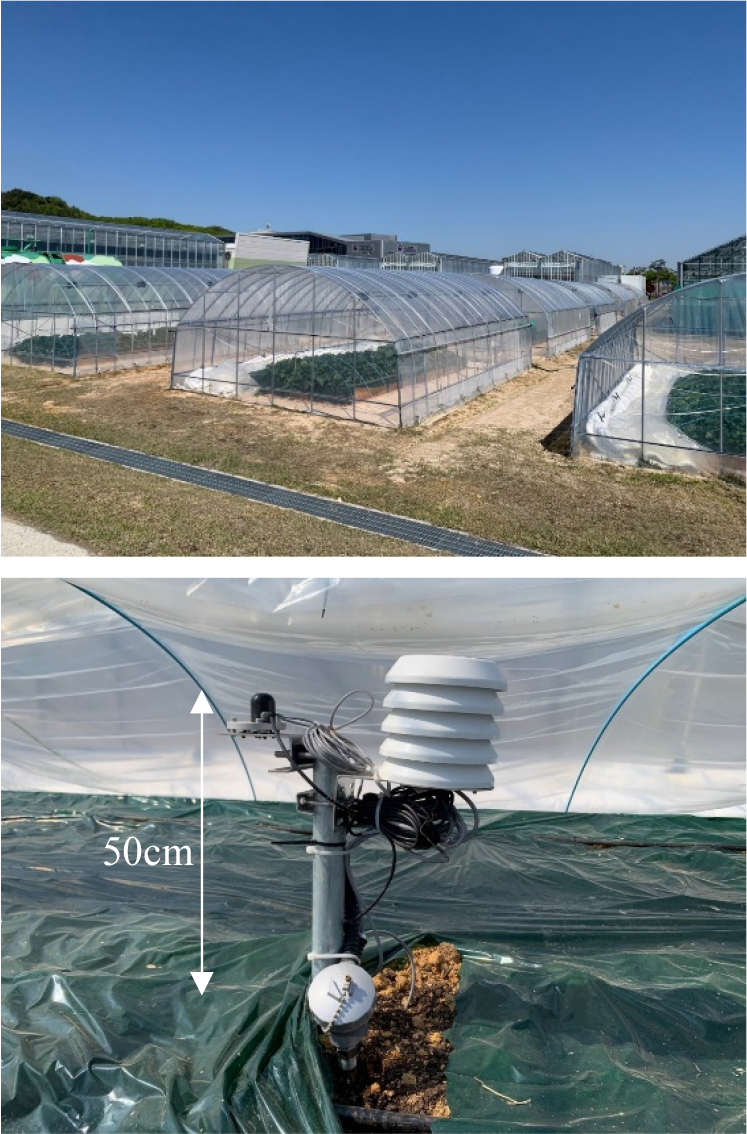
Fig. 1.
The greenhouse (left) was structured by iron pipe with 1.3 m eve height and 2.5 m ridge height, and covered with 0.15 mm thick plastic film having the surface area of 40 m2 with 5 m width and 8 m length, which was equipped with rolling type side window operated by the temperature sensor located at the center of greenhouse on 1.5 m height. Microclimate sensors (right) used for this experiment.
The grafted seedling of ‘Alchanggul’ Korean melon (The Kiban Co. Ltd., Ansung, Republic of Korea) grafted onto ‘Hidden Power’ (The Kiban Co. Ltd., Ansung, Republic of Korea) was planted on the separate soil bed, which has the size of 2.5 m wide and 6 m long, and 0.3 m high above ground, by 50 cm apart from right side and by the distance of 40 cm on 3 March. The soil bed was filled with soil made of red clay sand mixed with compost. The chemical properties were as follows; pH; 8.0, electrical conductivity (EC); 1.2 dS/m, available phosphorus; 337 mg/kg, NH4-N; 75 mg/kg, NO3-N; 187 mg/kg, exchangeable Ca; 3.18 cmol/kg, exchangeable Mg 3.64 cmol/kg, exchangeable K 4.57 cmol/kg. In order to maintain optimum night temperature poly- layered warm keeping fabrics was equipped on man-made plastic tunnel through the closing it before sunset and opening it after sunrise until 19 April. Irrigation and fertigation using liquid fertilizer ‘Mulpure 2’ (Daeyu co. Republic of Korea) was applied enough by trickle irrigation according to the growth vigor. The other crop managements such as training, topping, fruit setting by bumble bee pollinating, harvesting was done by the standard manual of Korean melon (RDA, 2018). After finishing three times harvesting until 2 June plants was exposed to pests and diseases by stopping the agro-chemical control for this experiment.
Three ventilation treatments by set point value at 45, 40, 35°C (control) started on 18 June when powdery mildew, mite and silverleaf whitefly were wide spread on the plants in all the greenhouse and stopped on 13 July. Set temperature value was accomplished by opening and closing of role-type side window responding by temperature sensor connected to control panel. When opening, operation time was 10s with 30s delay time. When closing, operation time was 15s with 30s delay time.
Plant growth and plant health situation was monitored every day and it was taken by photo at first day, five days and at 11 days after treatments. After 2 weeks of treatment the change of powdery mildew symptom, the population of silverleaf whitefly and two-spotted spider mite, and leaf rolling were investigated by observation revealing as categorical data defined by three levels as follows. 1; decrease, 3; stagnant, 5; increase. The number of male and female flowers bloomed on 15 nodes of the newly grown 5 shoots of plants in every experimental plot was counted at 26 days after treatment.
1. Experimental design and statistical analysis
Three treatments with 5 replications were placed by completely random design. The collected data were analyzed by SAS enterprise guide 7.1 version (SAS Institute, Cary, USA). The data of pests and disease occurrence, leaf rolling, and the number of flowers were analyzed by one-way ANOVA and presented with mean value. Significance was determined by Duncan multiple range test at 5% (p ≤ 0.05).
Results and Discussion
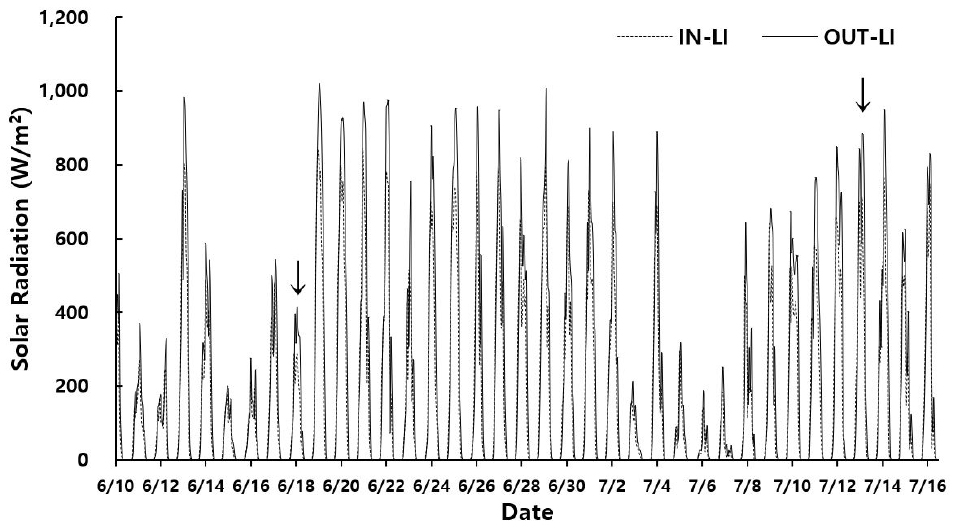
Solar radiation inside greenhouse was recorded for 37 days from 10 June to 16 July including high temperature treatment period of 26 days (Fig. 2). During the treatment period solar radiation inside greenhouse on day was about 80% of outside solar radiation. Mean solar radiation on day time was 335.8 W/m2 and the number of sunny days was 21 among 26 days.
During the treatment, mean, maximum and minimum temperature were fluctuated showing differences among treatments responding to outside weather condition (Fig. 3). According to the treatment, mean of day mean temperature were recorded by 30.5, 29.4, 28.0°C, and mean of day maximum temperature by 43.9, 40.3, 37.1°C, and mean of day minimum temperature by 20.4, 20.6, 20.4°C, respectively. Mean of day mean RH were recorded by 82.0, 79.0, 78.6%, and mean of day maximum RH by 95.4, 95.0, 96.1, and mean of day minimum RH by 59.4, 51.2, 50.4%, respectively. In view of time of day, temperature and RH differences among treatments were apparent on sunny day in the comparison between sunny day and rainy day (Fig. 4), and temperature and RH differences were continued for about 9 hours although we could not know how many times side window opened and closed. Physically, RH is getting down when temperature is rising up because saturation vapor pressure increases in closed condition. However, RH was higher at high temperature treatment than at lower temperature especially at 45°C, which was affected by the evapotranspiration of plant and soil (Ge et al., 2021). These results means that hot and humid air stayed longer at 45 °C than others. Meanwhile RH gap between 40°C and 35°C as control was not clear for 6 hours from 10 to 16 o’ clock.
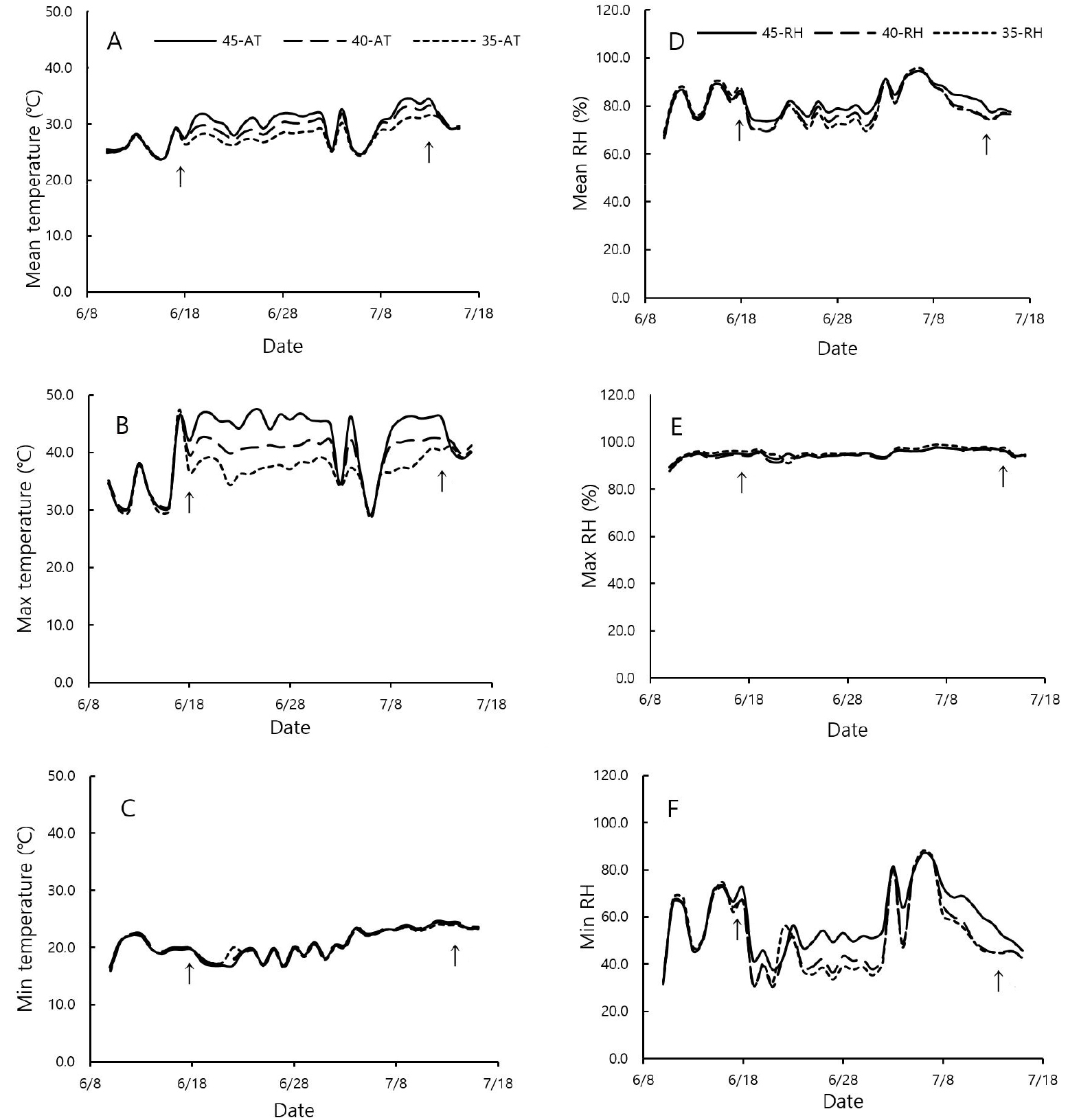
Fig. 3.
Changes of air temperature and RH inside greenhouse as affected by temperature treatment, which was accomplished by ventilation through side window operation according to set temperature of 45, 40, 35°C during the treatment. Arrow means starting and end point of treatment. Note: Lowercase A, B, C represent day mean, maximum, minimum temperature and D, E, F represent day mean, maximum, minimum RH, respectively.
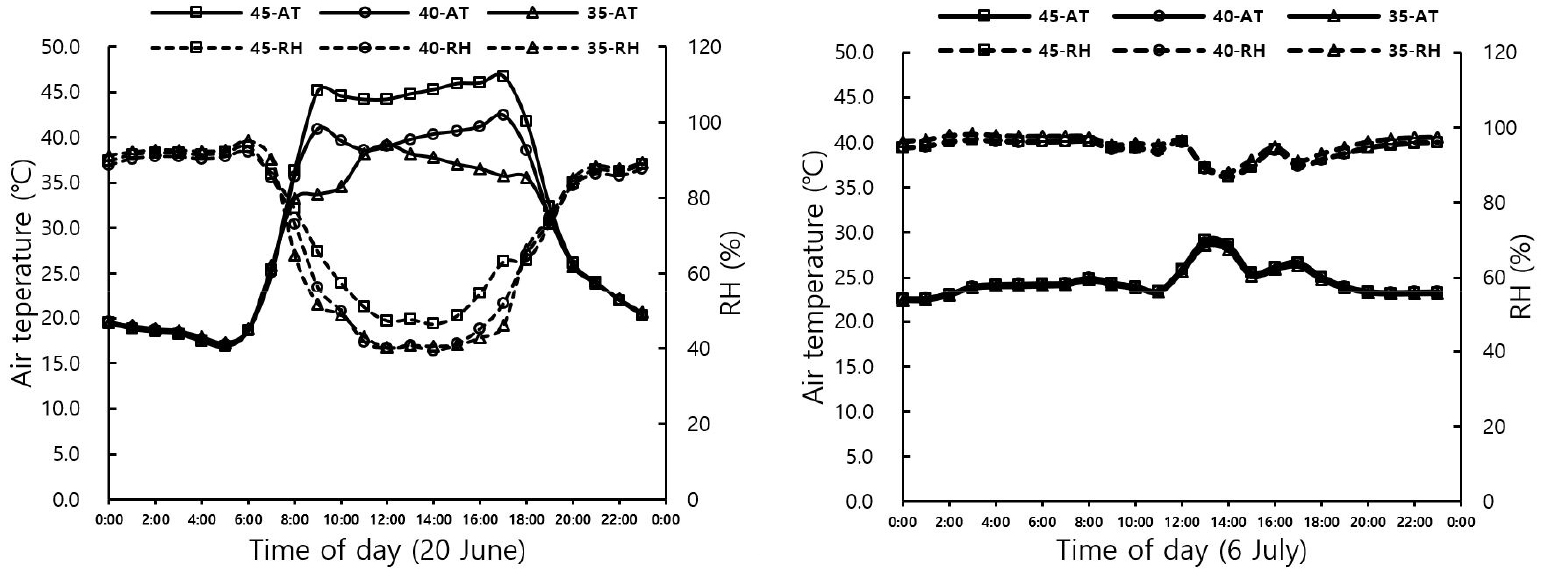
Fig. 4.
Comparison of air tempreature and RH inside greenhouse between sunny day (left, on 20 June) and rainy day (right, on 6 July) as affected by temperature treatment, which was accomplished by ventilation through side window operation according to set temperature of 45, 40, 35°C during the treatment.
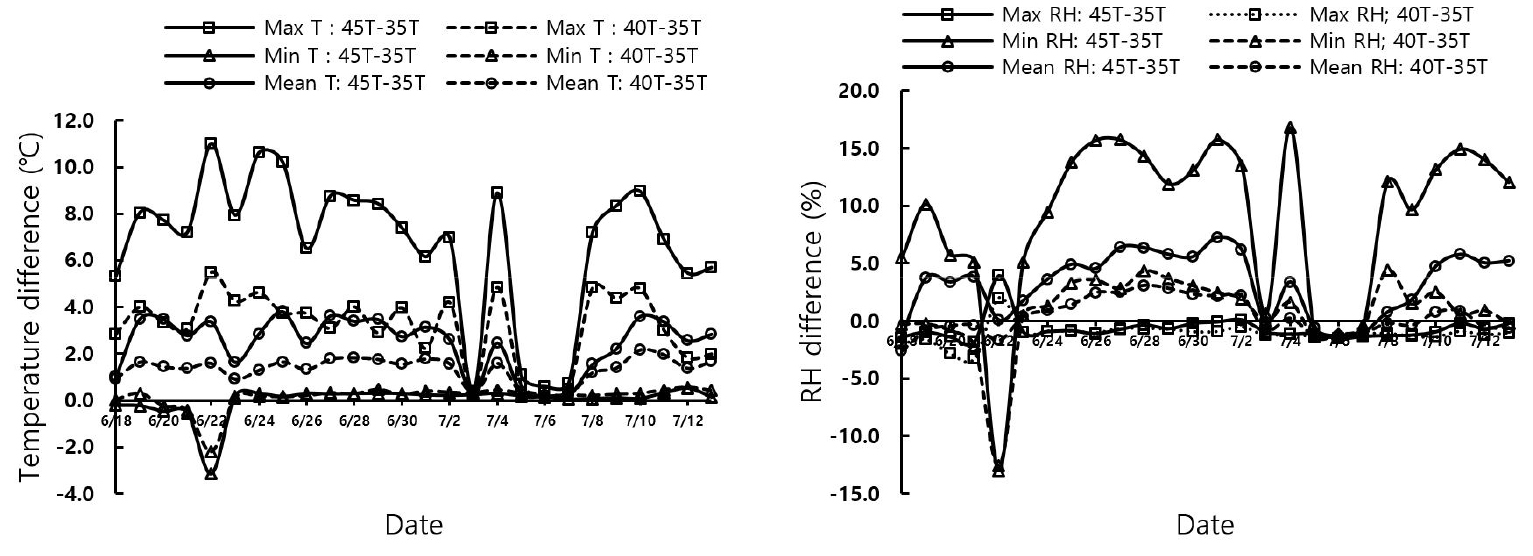
For more detail we revealed the differences of temperatures and RH with the comparison between 45°C and 35°C (control) and between 40°C and 35°C during the treatment (Fig. 5). The gap of day maximum temperature between 45°C and 35°C was in the range of 0.6 to 11.0°C showing 6.7°C on average during the treatment. The gap of day minimum RH between 45°C and 35°C was in the range of -1.3 to 7.2% showing 3.3% higher at 45°C on average. By these results, we could know that treatment effect was realized at day maximum temperature and at minimum RH.
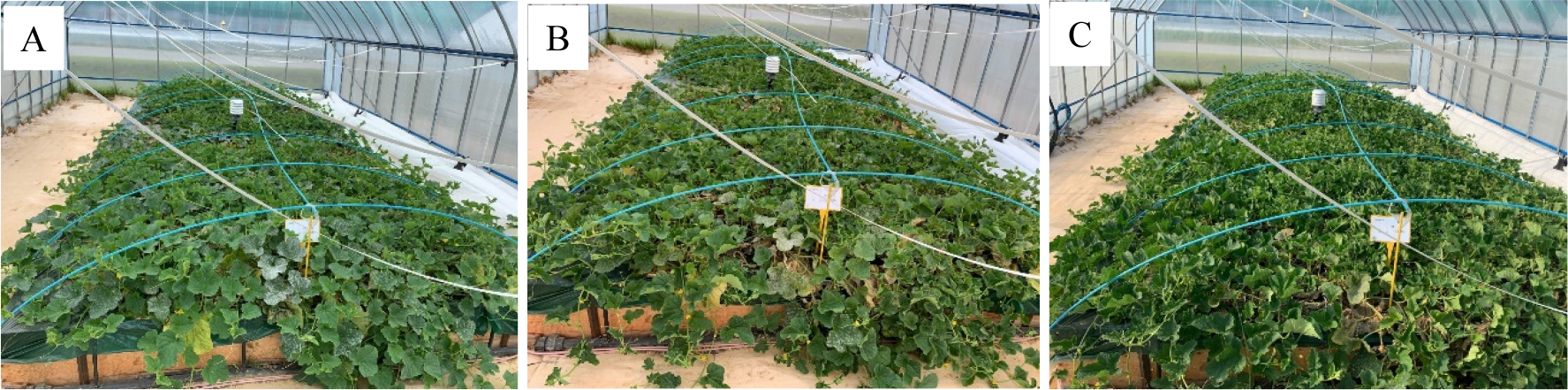
By everyday monitoring of plant growth and targeting two pests and one disease, we could know that temperature treatment effect starts to show on 5 days later. Therefore, we took photos at 5 and 11 days later and compared. As shown in Fig. 6, the visual growth and damage injured by powdery mildew and two-spotted spider mite was eventually recovered at 45°C.
In the investigation of pest and disease occurrence after 2 weeks, silverleaf whitefly and two-spotted spider mite were significantly decreased at 45°C (Table 1). Silverleaf whitefly is known as tropical/subtropical species (Wikipedia, 2021b). Generally, the populations of silverleaf whitefly reach their peak in summer whereas cooler climatic conditions (Luo et al., 2004; Subba et al., 2017). Heat shock can kill whitefly adult when they are exposed suddenly to high temperature above 41°C for 1hr even there is difference in heat tolerance between Bemisia tabaci (Gennadius) biotype B and Trialeurodes vaporariorum (Westwood) (Cui et al., 2008). Meanwhile, the effect of humidity on whitefly populations was controversial. Umar et al. (2003) reported that the correlation of whitefly population abundance and relative humidity was negative for whitefly population on some varieties of cotton. But, Jha and Kumar (2017) reported that population of whitefly with morning and evening RH had a positive relation in tomato. Recently, Thinnabut et al. (2020) reported that only dew point had a significant positive regression with whitefly populations in tomato grown in greenhouse reviewing that these differential results may depend on other conditions such as plant varieties, natural enemies, and cultural management. In our study, the decrease of silverleaf whitefly was thought to be induced by combination effect of high temperature and high RH at 45°C ventilation treatment for more than 2 weeks. Nevertheless, this treatment could not control this insect completely because they are survived in the greenhouse. Another concern is that this insect may adapt to high temperature like adapting to agro-chemicals (Luo et al., 2010).
Table 1.
Changes of pest and disease, and leaf rolling level as affected by temperature treatment, which was accomplished by ventilation through side window operation according to set temperature of 45, 40, 35°C during the treatment period.
| Treatment | Powdery mildewz | Silverleaf whiteflyz | Tow-spotted spider mitez | Leaf rollingy |
| 35℃ | 3.4 ax | 5.0 a | 3.0 a | 1.40 b |
| 40℃ | 2.6 a | 3.8 a | 3.4 a | 3.40 a |
| 45℃ | 2.2 a | 1.8 b | 1.0 b | 3.80 a |
In two-spotted spider mite, we could find out the high temperature with high humidity effect clearly after 14 days (Table 1). we could see no more dispersion of mite damage on plant leaves at 45°C treatment. Temperature and host plants affect the development and reproduction the spider mites (Praslička and Huszá, 2004; Zou et al., 2018). Farazmand (2020) reported recently in modelling study using cucumber leaves that the egg-to-adult development time of this insect decreased significantly with increasing temperature in the range of 15 to 32.5°C, except at 35°C and several models estimated the value of Tmax to be in the range from 32°C to 41°C. In relation to RH, spider mites are more easily controlled in greenhouse when high RH is maintained (Bouderaux, 1958). Oviposition was accelerated under low humidity through morphological responses of host cucumber leaves (Shibuya et al., 2016). Renkema et al. (2020) reported recently that the steam at 48°C could kill adult females and eggs on strawberry leaf discs within 2.7 and 1.9 hr, respectively.
Powdery mildew was not significantly different among treatment although showing decreasing pattern with the increase of temperature in this experiment. It is known that optimum temperature of powdery mildew occurrence in Korean melon is in the range of 15 to 28°C and was inhibited above 32°C (NCPMS, 2020). In addition, this disease occurs when the value of diurnal change of temperature and RH is high on spring season. Ventilation is a useful method to control microclimate especially air temperature and RH in the greenhouse whether it is forced or not. Generally, it can be inferred that indoor RH increases by plant transpiration in a closed condition. Roof and side ventilation were more effective than simple side ventilation to inhibit the occurrence rate of this disease in Korean melon (Yeo et al., 2015). The reason why the effect of high temperature on powdery mildew was not significant was that this disease was already enduring the powdery mildew even at control condition showing higher day temperature above 32°C on sunny day (Fig. 3).
Leaf rolling level was higher at 40°C and 45°C (Table 1). This means that high temperature gave this plant heat stress (Kadioglu et al., 2012). But the extent was not severe showing no concern about survival. We can see the rolled leaves in farming field during from late spring to summer season. The Korean melon is known as a cool sub-temperate crop, growing best with day temperatures between 24 and 28°C and night temperatures between 16 and 24°C (Wikipedia, 2021a). The cultivated Korean melon in Korea, however, is tolerant to high temperature by 40°C for short period (RDA, 2018).
In the investigation of the number of flowers, female flowers did not develop at 45°C showing decreasing from 3.1 to 2.5 between 35 and 40°C, and male flower decreased from 7.3 to 1.1 with the increase of temperature (Table 2). Total number of flowers were also decreased. It is known that the recently cultivated Korean melon is monoecious and fruiting well on the son vine and grandson vine and has a different flowering habit according to genetic characteristics and environmental condition, and that female flower changes to male flower more often in high temperature with long photoperiod condition (RDA, 2018). High temperature and photoperiod are known to more decisive environmental factors to determine sex expression than any other environmental factors (Lai et al., 2018). We could observe these changes in this study clearly. In another point of view, the decrease of flowering means that plant can afford to recover vegetative growth by reducing fruit setting that induce sink load when the plant vigor is weak (Nerson, 2004; Smith et al., 2018). Therefore, ventilation at 45 °C using side window operation could be an applicable practice to manage plant vigor and control above mentioned disease and pests occurred concurrently at Korean melon farm field during the summer season.
Table 2.
Flowering numbers observed at a newly grown shoot after 26 days as affected by temperature treatment, which was accomplished by ventilation through side window operation according to set temperature of 45, 40, 35°C during the treatment period.
| Treatment | No. of counted node | Female flower (/shoot) | Male flower (/shoot) |
| 35℃ | 15 | 3.12 az | 7.28 a |
| 40℃ | 15 | 2.48 a | 5.56 b |
| 45℃ | 15 | 0.00 b | 1.12 c |
Nevertheless, these ventilation control at high temperature should be carefully applied in Korean melon cultivation greenhouse because strong solar radiation following with extremely high temperature increases evapotranspiration induced by the increased vapor pressure deficit. Thus, enough water supply should be essentially needed to adapt to water stress and partial root-zone drying (Lamaoui et al., 2018). In addition, further studies are needed to quantify the final yield and quality of Korean melon after recovery of vegetative growth since oxidative damage is accelerated by exposal to drought and heat stress (Fahad et al., 2017).