© The Korean Society for Bio-Environment Control. All rights reserved.
ABSTRACT
서 언
최근 블루베리는 건강식품의 소재로 다양하게 개발되 고 있고 관련 산업 또한 새로운 각도로 재조명되고 있 다. 그러나 우리나라는 재배역사가 짧고 개원부터 수확 까지 체계적인 기술이 확립되어 있지 않아 정식 후 실 패하는 사례가 종종 발생되고 있다. 특히 대표적인 산성 식물로 다른 작물에 비해 까다로운 토양조건을 요구하는 데, 토양 pH는 4.0∼5.5(Eck and Childers, 1989; Hall et al., 1964), 유기물 함량은 3% 이상(Haynes and Swift, 1985; Korcak, 1989; Westwood, 1993) 되어야 정 상적인 생육이 이루어진다.
토양 pH가 높을 경우 생육이 부진하게 되므로(Brown and Draper, 1980;Haynes and Swift, 1986; Holmes, 1960) 개원 전에 예정지 토양을 분석하여 중성(pH 7.0) 이상이거나 약산성일 때에는 가을에 미리 유황분을 살포 하여 밭을 갈아준 후 이듬해 봄에 식재해야 한다(Scott et al., 1973; Spiers, 1982). 그러므로 블루베리 재배에서 는 토양 pH를 높이는 비료나 토양 개량자재 사용에 유 의해야 하며 이에 맞는 시비관리(Cain, 1952; Korcak, 1989;Merhaut and Darnell, 1995;Poonnachit and Darnell, 2004; Townsend, 1966)와 유기물 시용(Ancu et al., 2010; Grajkowski et al., 2007; Korcak, 1988; Spiers, 1986; Starast et al., 2002; Starast et al., 2007;Xie and Wu, 2009) 등 적정 토양환경 조성이 무엇보다 필요하다.
또한 블루베리는 건조에 약하고(Eck et al., 1990), 잡 초에 의한 양분과 수분의 경합이 크게 나타나는 과수 (Haman et al., 1997)이므로 정식 후 건전한 생육을 촉 진시키기 위해서는 지속적인 토양관리가 중요하다. 현재 블루베리 정식시 토양에 투입하고 있는 피트모스는 이러 한 조건을 충족시키는 재료로 널리 사용되고 있는데 (Ancu et al., 2010; Li et al., 2004; Spiers, 1986; Starast et al., 2002;Xie and Wu, 2009), 우리나라의 경 우 전량 수입에 의존하고 있는 실정이다.
따라서 본 시험은 피트모스를 대체할 수 있는 국내산 유기물의 토양 시용효과를 검토하고 피트모스와 기타 유 기물 혼합이 블루베리 생육 및 과실 품질에 미치는 영 향을 구명하고자 수행하였다.
재료 및 방법
1. 시험포장 조성 및 유기물 처리
본 시험은 2006년부터 2008년까지 3년간 전라북도농 업기술원 과수시험포장에서 수행하였다. 시험품종은 2년 생 북부 하이부시 블루베리 ‘Duke’로 2006년 4월 상순 노지에 정식하였다. 유기물 처리는 정식전 묘목 근권에 캐나다산 Berger® 피트모스를 단용(20L) 처리하는 방법 과 동일 피트모스 10L에 완숙된 소나무잎, 왕겨, 톱밥을 각각 10L씩 혼합 처리하는 4가지 방법으로 실시하였다.
시험 처리전 토양은 사양토의 과원으로 pH 6.3, 유기 물 2.0%, 유효인산 125mg/kg의 EC가 0.45dS·m-1인 토 양이었다(Table 1). 시비량은 10a당 퇴비 1,000kg, 유황 160kg, 비료(N-P-K : 21-17-17) 20kg을 기비로 시용하 였고 시험수는 5주씩 3반복으로 처리하였다. 재식 열은 동서방향 2×2.5m 간격으로 정식하였고 소나무 바크를 이용하여 10cm 두께로 토양 표면을 피복하고 점적호스 를 2조 설치하여 관수하였다.
Table 1.
Soil chemical properties of the experimental site determined before fertilization.
2. 생육 및 과실특성 조사
정식 후부터 첫 수확이 이루어진 재식 3년차까지 매년 신초신장기에 수고, 수폭, 신초수, 신초장, 엽수 등 생육 변화를 조사하였고 화방수와 착과수, 수확한 과실의 과 중, 가용성고형물함량, 산함량, 경도, 수량 등은 정식 후 3년째에 조사하였다. 과중은 1개 과립의 무게를, 당도는 디지털 당도계(PR-100, Atago Co., Ltd., Japan)로 측정 하였다. 산함량은 과즙 5mL를 증류수 20mL로 희석하여 지시약(phenolphthalein 1%액)을 1~2방울 첨가하고 0.1N NaOH로 적정한 후 구연산 값으로 환산하였다. 과피경도 는 경도계(SD-700, Sun Scientific Co., Japan)로 직경 3mm의 probe를 이용하여 측정하였다.
3. 토양수분 조사
토양수분의 변화는 묘목 정식 후 4월 중순부터 11월 하순까지 생육기간 중에 측정하였는데 수분측정 센서를 지중 10cm 부근의 블루베리 근권에 꽂아 측정하였고 데 이터 로거 CR10X(Campbell Scientific, Inc., USA)를 이 용하여 매일 측정된 자료를 수집하였다.
4. 유기물 및 토양 분석
유기물의 주요성분은 원예용 상토 분석법(RDA, 2002) 에 준하여 조사하였으며 토양화학성은 농촌진흥청 분석 요령(RDA, 2000)에 따라 pH, EC, 유기물, K, Ca, Mg, 인산과 질소함량을 조사하였다.
결과 및 고찰
시험재료로 처리한 유기물을 분석한 결과, pH는 피트 모스가 4.3으로 가장 낮았고 소나무잎 4.8, 왕겨 7.3, 톱 밥은 5.7이었다. 유기물함량은 톱밥이 99.2%로 가장 높고 소나무잎 96.6%, 피트모스 94.3%, 왕겨는 83.8% 순으로 낮았다. 유효인산과 K는 왕겨가 78mg·L-1, 5.15cmol+·L-1 로 높았고 Ca, Mg과 T-N는 피트모스에서 각각 1.99cmol+·L-1, 3.64cmol+·L-1과 0.99%로 가장 높게 나타 났다(Table 2).
Table 2.
Chemical properties of the organic materials used in the experiment.
정식전 토양에 유기물을 투입, 혼합한 후 토양 화학성 을 측정한 결과(Table 3), pH는 피트모스 단용 처리에서 5.1, 피트모스+소나무잎 처리에서 5.2, 피트모스+왕겨 처 리에서 5.9, 피트모스+톱밥 처리에서 5.4를 나타내었다. 또한 모든 처리에서 유기물 함량은 10% 이상이 되어 블루베리 생육에 적합한 토양이 되었다. 인산은 피트모 스+왕겨 처리 토양에서 145mg·kg-1로 가장 높았고 그밖 에 K, Ca, Mg 등 양이온 성분도 모든 처리에서 증가되 는 경향이었다. EC는 피트모스+톱밥처리에서 0.48dS·m-1 로 가장 낮았고 피트모스+왕겨 처리에서 1.23dS·m-1를 나타내었다.
Table 3.
Soil chemical properties measured after the addition of organic materials to the soil before planting.
일반적으로 블루베리는 유기물 함량이 적은 토양에서 는 정상적인 생육이 이루어지지 않는다고 알려져 있다 (Haynes and Swift, 1985; Korcak, 1989; Westwood, 1993). 유기물 시용은 토양의 화학성, 물리성, 생물성 측 면에서 효과를 볼 수 있다. 화학성 개선으로는 양분공급, 보비력 증대, 생리활성작용의 증대이고(Argo, 1998; Beardsell et al., 1979; Hassink et al., 1993) 물리성 개 선으로는 유기물의 시용에 따라 토양의 입단화가 촉진되 어 공극량이 증대해서 통기성, 투수성, 배수성, 보수성 등이 개선된다(Mamedov et al., 2007;Tisdall and Oades, 1982). 또한 생물성에 있어 효과는 토양 미생물 의 활동이 활발해진다는 것이다(Bach et al., 2010; Chau et al., 2011). 이러한 측면을 고려하면 하이부시 블루베리 재배에서 토양내 유기물 종류 및 함량은 매우 중요한 생육조건이 될 수 있다.
2006년 정식 전에 유황과 유기물을 토양에 투입한 후 연차별 토양 pH 변화를 조사한 결과(Fig. 1) 해가 지날수 록 pH는 점점 낮아져 시험 3년차에 모든 유기물 처리에 서 pH 4.2~4.5를 나타내었다. 이는 토양에 투입한 유황이 점차 녹으면서 pH 변화에 영향을 미친것으로 판단되었다.
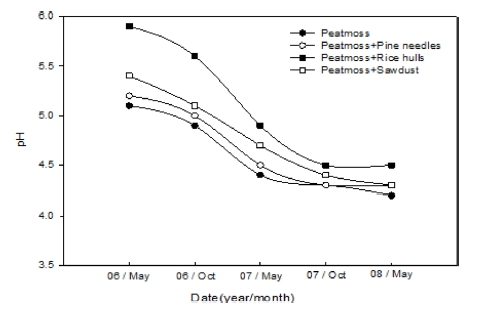
Fig. 1
Changes of pH in the soils incorporated with peatmossbased organic material mixtures including pine needles, rice hulls or sawdust.
유기물 조성에 따른 생육 시기별 토양수분 함량(Fig. 2) 은 피트모스+소나무잎>피트모스단용>피트모스+톱밥>피트 모스+왕겨 순으로 높게 유지되었다.
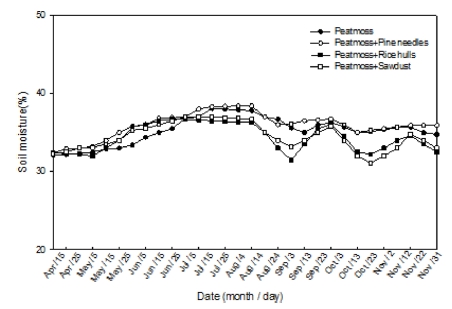
Fig. 2
Changes of soil moisture content in the soils incorporated with peatmoss-based organic material mixtures including pine needles, rice hulls or sawdust.
뿌리 분포가 얕은 블루베리는 생육과 과실의 발육을 위해서 비교적 많은 양의 수분을 필요로 하는 과수이다 (Benoit et al., 1983; Gough, 1980;Hamam et al., 1988). 본 시험의 결과로서 토양 내 유기물 처리에 의해 수분함량은 상당히 달라질 수 있음을 알 수 있었다. 이 러한 결과는 White(2006)가 톱밥을 혼합한 토양에 심은 블루베리의 경우 관수량이 늘어 대조구에 비해 5~6번 더 관수하였다고 보고하는 등 유기물의 처리종류에 따른 관수량 차이를 확인한 바 있다. 따라서 블루베리 정식 시 유기물의 처리종류에 따라 시기별 관수량, 관수방법 등이 반드시 조절되어야 할 것으로 판단된다.
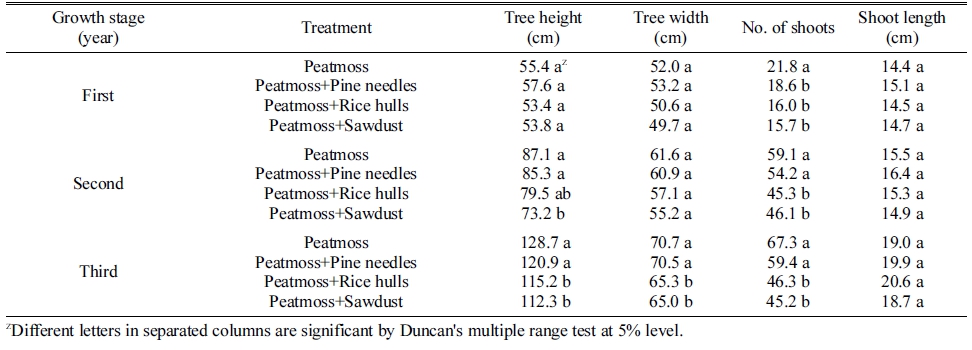
유기물 처리에 의한 정식 후 생육은 재식 1년차에서는 신초수 외에 큰 차이가 없었고 재식 2년차에서는 피트모 스 단용과 피트모스+소나무잎 처리에서 수고가 85~87cm 로 크고 신초수가 54~59개로 많아 다른 처리와 차이가 있었다(Table 4). 재식 3년차 생육은 피트모스 단용과 피 트모스+소나무잎 처리에서 수고와 수폭이 크고 신초수 가 많았다. 또한 화총수와 착과수 역시 피트모스 단용과 피트모스+소나무잎 처리에서 높게 나타나 초기 수량 확 보에 유리하였다(Fig. 3). 블루베리 정식전 유기물 조성 에 관한 한 연구(Iancu et al., 2008)에서 피트모스와 유 기질 비료를 50%씩 혼용처리하고 3년 후 생육과 수량 을 비교한 결과 침엽수 낙엽만 넣은 처리에 비해 신초 의 생장이 증가하였으며 수량과의 상호관계 또한 유의성 이 높게 나타났다고 보고한 바 있다.
Table 4.
Effects of organic materials incorporation with the soil on the growth parameters in highbush blueberry ‘Duke’.
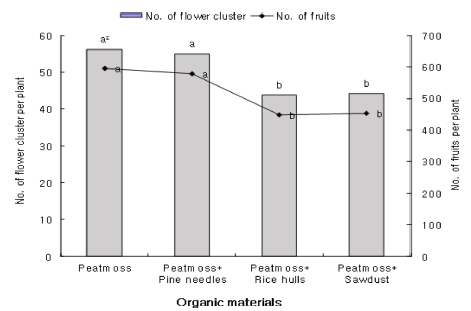
Fig. 3
Effects of peatmoss-based organic materials on the number of flower clusters and fruits in highbush blueberry ‘Duke’. These data were collected in the third year after planting. zDifferent letters indicate a significant difference between treatments according to Duncan’s multiple range test at 5% level.
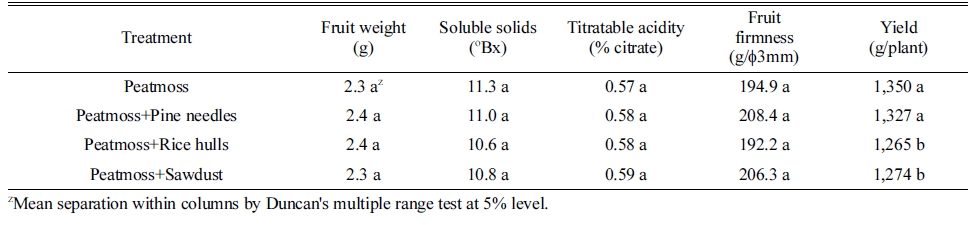
유기물 처리별 과실특성을 조사한 결과, 피트모스 단용 처리에서 가용성고형물 함량이 11.3 oBrix로 가장 높게 나타났고 피트모스+소나무잎 처리에서 경도가 208.4g/ φ3mm으로 다소 높게 측정되었으나 다른 처리구와의 통 계적인 유의차는 없었다. 일반적으로 블루베리는 재식 당 년과 2년차에는 화아를 제거하여 결실이 되지 않도록 하 고 있는데(Eck et al., 1990), 본 연구에서 재식 3년차에 첫 수확량을 조사한 결과 피트모스 단용 및 피트모스+소 나무잎 처리구에서 각각 주당 1,350g, 1,327g이 수확되어 왕겨나 톱밥처리에 비해 높게 나타났다(Table 5). 따라서 소나무잎은 하이부시 블루베리 재배에 있어 초기 수량을 확보할 수 있는 유용한 유기물로 판단되었다. 금후 본 연 구결과를 기초로 재배방법에 따른 유기물 조성방법, 양수 분 관리 등 세부 시험이 수행된다면 국내 블루베리 산업 의 생산성 향상에 도움이 될 것이다.
Table 5.
Effects of organic materials incorporation with the soil on the fruit quality characteristics in highbush blueberry ‘Duke’.
사 사
본 연구는 농촌진흥청 공동연구사업(과제번호: PJ006027) 지원에 의해 이루어진 것임
References
Ancu, I.M., P. Mladin, and S. Ancu. 2010. The planting substrate effects on some growth characteristics of seven blueberry cultivars. Bul. Univ. Agr. Sci. Veterinary Medicine Cluj-Napoca Hort. 67:91-95.
Argo, W.R. 1998. Roots medium chemical properties. Hort Technology. 8:481-490.
Bach, E.M., S.G. Baer, C.K. Meyer, and J. Six. 2010. Soil texture affects soil microbial and structural recovery during grassland restoration. Soil Biol. Biochem. 43:2182-2191.
Beardsell, D.V., D.G. Nichols, and D.L. Jones. 1979. Physical properties of nursery potting-mixtures. Scientia Horticulturae. 11:1-8.
Benoit, G.R., W.J. Grant, A.A. Ismail, and D.E. Yarborough. 1983. Effect of soil moisture on the potential and actual yield of lowbush blueberries. Can J. Plant Sci. 64:683-689.
Brown, J.C. and A.D. Draper. 1980. Differential response of blueberry(Vaccinium) progenies to pH and subsequent use of iron. J. Amer. Soc. Hort. Sci. 105:20-24.
Cain, J.C. 1952. A comparison of ammonium and nitrate nitrogen for blueberries. Proc. Amer. Soc. Hort. Sci. 59:161-166.
Chau, J.F., A.C. Bagtzoglou, and M.R. Willing. 2011. The effect of soil texture on richness and diversity of bacterial communities. Environ. Forensics. 12:333-341.
Eck, P. and N.F. Childers. 1989. Blueberry culture. 4th ed. Rutgers University Press. New Brunswick, London.
Eck, P., R.E. Gough, I.V. Hall, and J.M. Spiers. 1990. Blueberry management. p. 273-301. In: G.J. Galletta and D.G. Himelrick (eds.). Small fruit crop management. Prentice Hall, Englewood Cliffs, New Jersey.
Gough, R. 1980. Root distribution of Coville and Laterblue highbush blueberry under sawdust mulch. J. Am. Soc. Hort. Sci. 105:576-578.
Grajkowski, J., I. Ochman, and Z. Mulinski. 2007. Firmness and antioxidant Capacity of highbush blueberry(Vaccinium corymbosum L.) Grown on. Three types of organic bed. Vegetable Crops Res. Bul. 66:155-159.
Hall, I.V., L.E. Aalders, and L.R. Townsend. 1964. Nitrogen uptake in blueberry fields. Can. J. Plant Sci. 44:30-36.
Haman, D.Z., A.G. Smajstrla, R.T. Pritchard, and P.M. Lyreme. 1997. Response of young blueberry plants to irrigation in Florida. HortScience 32:1194-1196.
Hamm, D.Z., A.G. Smajstrla, and P.M. Lyrene. 1988. Effects of irrigation and ground cover on growth of blueberry. Proc. Fla. State Hort. Soc. 101:235-238.
Hassink, J., L.A. Bouwman, K.B.Z. Wart, J. Bloem, and L. Brussaard. 1993. Relationships between soil texture, physical protection of organic matter, soil biota, and C and N mineralization in grassland soils. Geoderma. 57:105-128.
Haynes, R.J. and R.S. Swift. 1985. Effects of soil acidification on the chemical extractability of Fe, Mn, Zn and Cu and their uptake by highbush blueberry plants. Plant and Soil. 84:201-212.
Haynes, R.J. and R.S. Swift. 1986. Effect of soil amendments and sawdust mulching on growth, yield and leaf nutrient content of highbush blueberry plants. Sci. Hort. 29:229-238.
Holmes, R.S. 1960. Effect of phosphorus and pH on iron chlorosis of the blueberry in water culture. Soil Sci. 90:374-379.
Iancu, M., I. Ancu, P. Mladin, S. Ancu, G. Mladin, and V. Chitu. 2008. Influence of the planting substrate on blueberry growth and yield. Bulletin UASVM, Hort. 65:308-313.
Korcak, R.F. 1988. Nutrition of blueberry and other calcifuges. Hort. Rev. 10:183-227.
Korcak, R.F. 1989. Variation nutrient requirements of blueberries and other calcifuges. HortScience 24:573-578.
Li, Y., T. Xuedong, W. Lin, and Z. Zhang. 2004. Effect of organic material on soil properties, plant growth, leaf photosynthesis, nutrient uptake and mycorrhizal infection of blueberries. Acta Hort. 715:375-380.
Mamedov, A.L., S. Beckmann, C. Huang, and G.J. Levy. 2007. Aggregate stability as affected by polyacrylamide molecular weight, soil texture, and water quality. Soil Sci. Soc. Am. J. 71:1909-1918.
Merhaut, D.J. and R.L. Darnell. 1995. Ammonium and nitrate accumulation in containerized southern highbush blueberry plants. HortScience 30:1378-1381.
Poonnachit, U. and R. Darnell. 2004. Effect of ammonium and nitrate on ferric chelate reductase and nitrate reductase in Vaccinium species. Ann. Bot. 93:399-405.
Rural Development Administration (RDA). 2000. Analysis of soil and plant. NIAST, Suwon.
Rural Development Administration (RDA). 2002. Standard analysis of substrate. NIAST, Suwon.
Scott, D.H., A.D. Draper, and Darow, G.M. 1973. Commercial blueberry growing. USDA, Washington, DC.
Spiers, J.M. 1982. Fertilization, incorporated organic matter and early growth of rabbiteye blueberries. J. Amer. Soc. Hort. Sci. 107:1054-1058.
Spiers, J.M. 1986. Root distribution of 'Tifblue' rabbiteye blueberry as influenced by irrigation, incorporated peatmoss, and mulch. J. Amer. Soc. Hort. Sci. 111:877-880.
Starast, M., K. Karp, and T. Paal. 2002. The effect of using different mulches and growth substrates on half-highbush blueberry(Vaccinium corymbosum×V. angustifolium) cultivars 'Northblue' and 'Northcountry'. Acta Hort. 574:281-286.
Starast, M., K. Karp, E. Vool, U. Moor, T. Tonutare, and T. Paal. 2007. Chaemical composition and quality of cultivated and natural blueberry fruit in Estonia. Vegetable Crops. Res. Bul. 66:143-153.
Tisdall, J.M. and J.M. Oades. 1982. Organic matter and waterstable aggregates in soils. J. Soil Sci. 33:141-163.
Townsend, L.R. 1966. Effect of ammonium and nitrate nitrogen on the growth of the lowbush blueberry. Can. J. Plant. Sci. 46:209-210.
Westwood, M.N. 1993. Temperate-zone pomology. Timber Press, Portland, OR, USA. p. 100-101.
White, L.D. 2006. The effect of pre-plant incorporation with sawdust, sawdust mulch, and nitrogen fertilizer rate on soil properties and nitrogen uptake and growth of 'Elliot' highbush blueberry. Mater Diss, Oregon State Unic., 1-63.
Xie, Z.S. and X.C. Wu. 2009. Studies on substrates for blueberry cultivation. Acta Hort. 810:513-520.